One application. 13 lenders from our 50+ network. Funded in 24 to 48 hours.
Apply Now One application routed to where you qualify.
Every Apply button starts the same single application. Your chosen lender is prioritized first.












| Approach | Monthly | Total interest | Paid off in |
|---|---|---|---|
| Minimum payments only | Starts at $450, declining | $26,120 | Over 33 years |
| Card, fixed $500 per month | $500 | $7,529 | 46 months |
| Consolidation at 19.99% | $456 | $6,906 | 4 years |
| Consolidation at 34.99% | $584 | $13,055 | 4 years |
A debt consolidation loan is an instalment loan used to pay off several balances at once, so that one payment on one schedule replaces many. It changes two things: the number of payments, and the rate. The first is convenience. The second is the only part that saves money, and it only saves money in one direction.
If the loan's rate is below the average rate on the debts it replaces, you pay less interest in total. If it is above, you pay more, however tidy the single payment looks. That is the whole test, and it is worth running before anything else on this page.
On Smarter Loans, from January 2026 to June 2026, debt consolidation was the stated purpose on 20.5% of personal loan applications, the second most common reason to borrow after paying off bills at 33.0%. It was also the largest by amount: consolidation requests averaged $8,167 across 2,781 applications, against $5,888 for all personal applications and $4,616 for paying off bills.
| Stated purpose | Share of personal applications | Average request |
|---|---|---|
| Pay off bills | 33.0% | $4,616 |
| Debt consolidation | 20.5% | $8,167 |
| Other | 17.9% | $5,141 |
| Medical expenses | 5.8% | $4,445 |
| Improve credit | 4.6% | $5,897 |
Source: Smarter Loans platform data, personal loan applications of $1,500 to $35,000, January 2026 to June 2026.
The size gap is the point. A bill is a gap to be covered; a consolidation is a restructuring of what is already owed, and it carries the balances of several accounts. That is why consolidation is the one purpose where the rate matters more than the amount, and why a consolidation at the wrong rate is the most expensive mistake on this page.
At the everyday scale, under $1,500, consolidation was 5.1% of applications and averaged $633. Small balances are usually better cleared than consolidated; the arithmetic below explains why.
Take $8,000 of card balances at a typical card rate of 21.99%, and three ways of paying it off over 36 months.
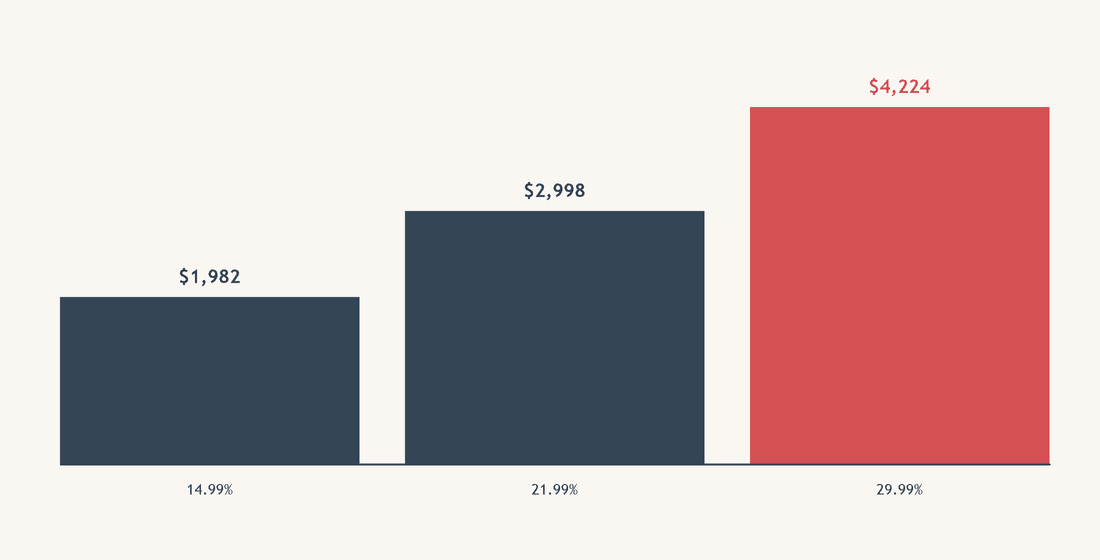
| Rate on $8,000 over 36 months | Monthly payment | Total interest |
|---|---|---|
| 14.99% APR | about $277 | about $1,982 |
| 21.99% APR (the cards, paid on the same schedule) | about $306 | about $2,998 |
| 29.99% APR | about $340 | about $4,224 |
A consolidation loan at 14.99% saves about $1,016 against paying the cards down on the same schedule. A consolidation loan at 29.99% costs about $1,226 more than the cards did. Same balance, same term, and the sign of the saving depends entirely on where the loan's rate sits against the debts it replaces.
Two things make the comparison honest. First, "the same schedule" matters: most people paying cards pay the minimum, which stretches the term and the interest far beyond 36 months, so a consolidation loan's fixed term is often the larger saving in practice. Second, the consolidation only works if the cards stay clear afterwards; a consolidation that frees up card limits which then refill is a doubling of debt, not a restructuring.
The debt payoff calculator runs your own balances against any loan rate and term and shows the saving or the cost. Run it before applying, not after.
Most searches that land here include the words "bad credit," and the answer has two halves.
The first half is availability. Eight of the thirteen lenders on this page will consider a poor score, and lenders here read bank deposits before the score. On our platform in the first half of 2026, 46.3% of personal applicants carried a fair score, 23.6% poor and 22.1% no usable score; consolidation applicants are drawn from the same distribution. Among applicants stating consolidation as their purpose, 69.4% carried a poor or fair score.
The second half is the arithmetic above. A poor-score file prices near the top of a lender's range, often near the 35% federal cap, and a consolidation at that rate is above most card rates. For a borrower with bad credit the honest question is not "can I consolidate" but "is the rate I will be offered below the rate on what I owe." Where it is not, the better route is often to pay the highest-rate balance first while the score recovers, and consolidate later at a lower rate; our guide to going from bad credit to over 700 covers that sequence, and the bad credit loans page covers how lenders here assess the file.
Thirteen lenders on this page offer personal loans from $100 to $75,000 unsecured, from 8.99% APR up to the 35% federal cap. Income floors run from $1,000 to $2,500 a month from any regular source, most commonly $1,500.
A consolidation application is read like any other, with one addition. The lender sees the balances you intend to clear, because they are debiting the same account it is reading. A consolidation that would leave the account with a lower total monthly outflow reads well; one that adds a payment without removing any reads as new debt, which is what it would be.
Every lender here is subject to the 35% cap on instalment loans. Where your file lands within a lender's range is set by deposit regularity, existing commitments and the credit band, in that order. Our guide to using a personal loan to consolidate debt covers the process end to end.
Paying the highest-rate balance first, with the same money a consolidation payment would take, clears the most expensive debt fastest and costs nothing to set up. It works where the balances are few and the rates differ widely.
A balance transfer to a card with a promotional rate can beat any loan on this page for a borrower who qualifies and who can clear the balance inside the promotional window. Most people with the credit profile of this page's applicants will not qualify, and the rate after the window is often higher than the cards it replaced.
A credit counselling agency can arrange a debt management plan with creditors at reduced or zero interest. It affects the credit file and it takes time, and for a large balance at a high rate it can be the cheapest route of all. The Financial Consumer Agency of Canada's guidance on debt explains the options and how to find a non-profit agency.
A consolidation loan is the right answer where the rate offered is below what you owe, the balances are large enough that the saving matters, and the cards will stay clear afterwards. That is a narrower case than the searches suggest, and it is a real one.
All personal loan options are on the personal loans hub. If what you need is a fixed loan for a single purpose rather than a restructuring, the instalment loans page covers the plain product; the budget calculator shows what is left after any payment.
Source for all platform figures on this page: Smarter Loans personal loan applications, January 2026 to June 2026.
Reviewed by Vlad Sherbatov, Co-Founder and President, Smarter Loans. Last reviewed 8 September 2026. Platform figures cover applications from 1 January to 30 June 2026.

How Debt Consolidation Works in Canada
What debt consolidation is, what it does to your credit score, and how it compares with a consumer proposal or credit counselling.
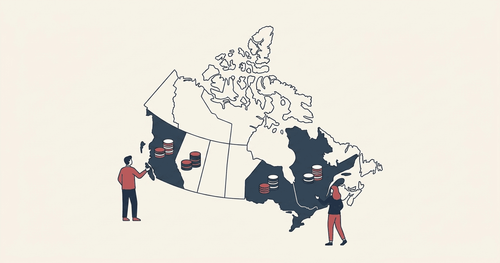
What Canadians Borrow to Consolidate, by Province
Canadians applying to consolidate debt asked for an average of $6,659 in the year to July 2026, across more than 8,000 Smarter Loans applications. Newfoundland and Labrador led every province at $7,948 and New Brunswick sat lowest at $6,133.
What Canadians Owe When They Decide to Consolidate
Applicants reporting unsecured debt on a Smarter Loans personal loan application carried an average of $13,410 in the year to July 2026. Those applying to consolidate asked for $6,659, about half of what they owe.

Debt Consolidation Loans in Canada
What a consolidation loan costs in Canada, the credit score lenders want, and how to tell whether consolidating actually saves you money.
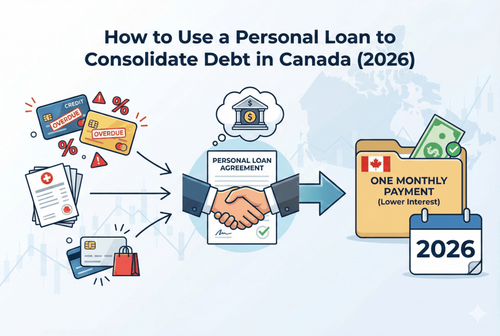
How to Consolidate Debt With a Personal Loan
The steps to consolidate debt with a personal loan in Canada, what lenders check, and the mistakes that leave you paying more than before.
Only when its rate is below the rates on the debts it replaces. On $8,000 over 36 months, a loan at 14.99% saves about $1,016 against paying cards at 21.99% on the same schedule; a loan at 29.99% costs about $1,226 more. Run your balances through a payoff calculator before applying, and consolidate only if the offer beats what you owe.
On our platform in the first half of 2026, consolidation requests averaged $8,167 across 2,781 applications, the largest of any purpose and well above the $5,888 average for all personal loans. Consolidation was 20.5% of personal applications, second only to paying off bills.
Eight of the thirteen lenders on this page will consider a poor score, and all of them read bank deposits before the score. The harder question is the rate: a poor-score file prices near the 35% federal cap, which is above most card rates, so consolidating at that rate usually costs more than it saves. Paying the highest-rate balance first while the score recovers is often the better route.
A consolidation loan is new borrowing at a new rate that pays off the old balances; you owe the lender. A debt management plan is arranged by a credit counselling agency with your existing creditors, usually at reduced or zero interest; you owe the same creditors on new terms, and it is noted on your credit file. For large balances at high rates the plan can be cheaper.
Have a plan for them before you apply. A consolidation that clears the cards and then refills them doubles the debt rather than restructuring it. Closing accounts affects credit utilisation and history, so lowering limits or keeping one card with a rule you will keep is often the better choice; the point is that the balances stay at zero.