One application. 15 lenders from our 50+ network. Funded in 24 to 48 hours.
Get Funded One application routed to where you qualify.
Every Apply button starts the same single application. Your chosen lender is prioritized first.













Most of it is small. On Smarter Loans, from January 2026 to June 2026, 68.8% of business loan requests were for under $50,000 and 36.9% for under $10,000. Only 13.5% asked for more than $150,000, and that top slice is what pulls the overall average up to $94,465. Read the average alone and you would think Canadian business borrowing is a six-figure activity. Read the distribution and it is mostly payroll, inventory and the gap before a customer pays.
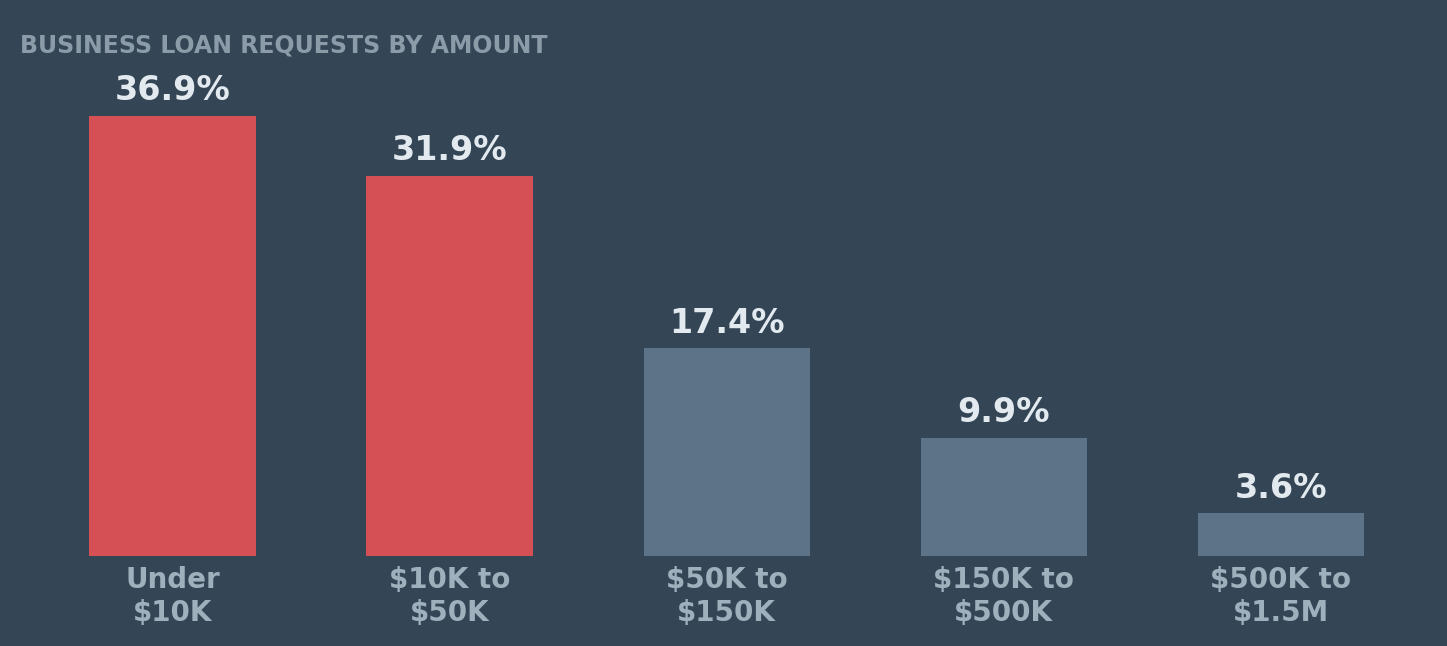
| Request size | Share of business demand |
|---|---|
| Under $10,000 | 36.9% |
| $10,000 to $50,000 | 31.9% |
| $50,000 to $150,000 | 17.4% |
| $150,000 to $500,000 | 9.9% |
| $500,000 to $1.5 million | 3.6% |
Source: Smarter Loans Lending Demand Index, first half 2026.
Who is asking matters as much as how much. The average business applying through Smarter Loans has been trading 7.5 years, but 31.1% of applications come from businesses under two years old, and that younger third asks for $82,937 on average against $108,510 for businesses trading five years or more. Businesses reporting $100,000 to $249,000 in annual revenue asked for $49,956. Those are the files the fifteen lenders on this page were built to read.
Almost every search that lands here is looking for something a bank did not offer: fast, online, private, or available to a business the bank called too young. That is what this page lists, and it is worth being clear about the trade.
Banks are cheaper. They want two years of reviewed financial statements, security over assets, a personal guarantee, and several weeks. For a business that clears those hurdles, a bank term loan or operating line is the lowest-cost money in the country, and nothing on this page competes with it on price.
The lenders on this page are online, assessed on bank deposits rather than statements, and decide in days. They lend to businesses trading six months, sometimes three, and to owners whose personal credit a bank would decline. They charge more for all of that. Eleven of the fifteen fund businesses under twelve months old, which is the single biggest difference from a bank.
The honest sequencing is bank first if you can, this page if you cannot yet or cannot wait, and refinancing to the bank once your statements support it.
Most businesses that land here will do all three over five years: an online lender for the first eighteen months, a bank line once the second year's statements are in, and this page again for the gap the bank line does not cover. There is no shame in the sequence. It is how most Canadian small businesses are actually financed.
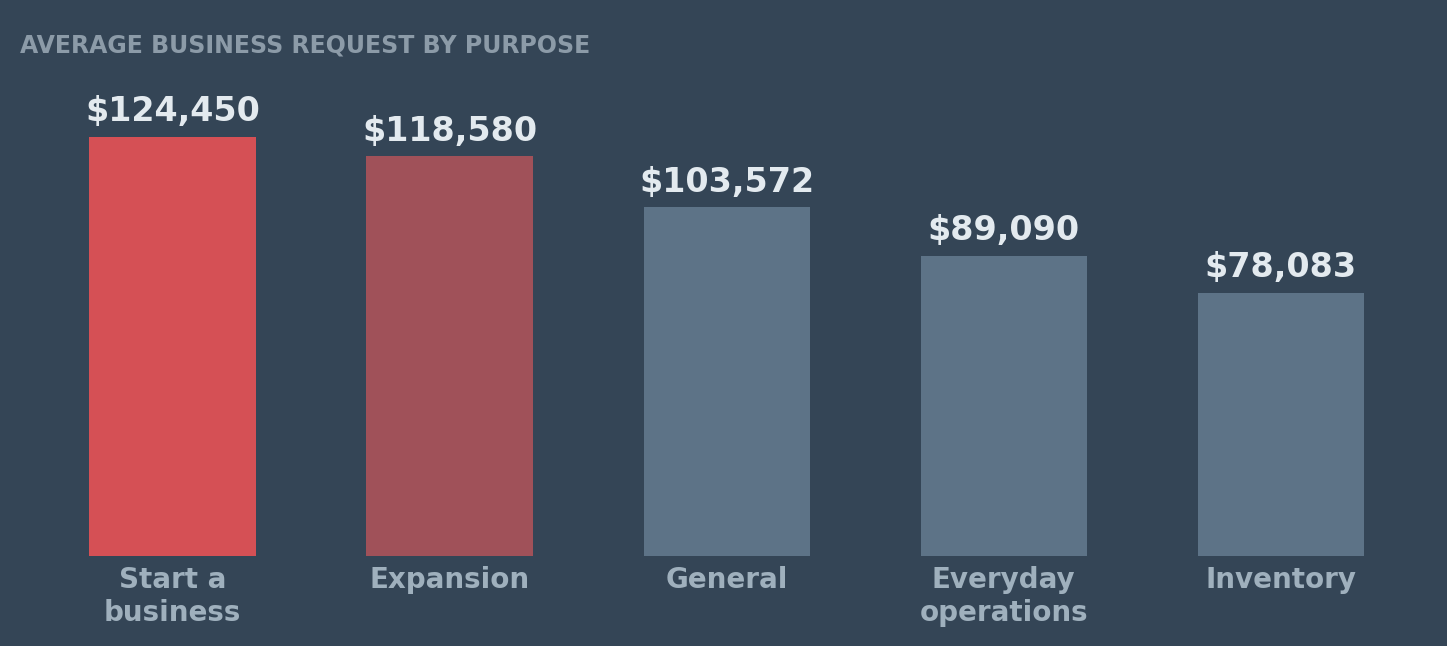
| Stated purpose | Average request |
|---|---|
| Start a business | $124,450 |
| Expansion | $118,580 |
| General business | $103,572 |
| Everyday operations | $89,090 |
| Purchase inventory | $78,083 |
Growth capital and operating capital are different amounts and different products. Starting a business and expanding one both average above $110,000 and are term-loan shaped: a known sum, a known use, a multi-year payoff. Everyday operations and inventory sit closer to $80,000 and are working-capital shaped: recurring, short, sized to a gap.
One number in that table carries a story of its own. Applicants starting a business through our business channel ask for $124,450 on average. Applicants who select the same purpose on a personal application ask for $9,646. Those are two different founder populations, one raising growth capital and one bootstrapping out of personal credit, and the second is invisible to most small business statistics.
Eight pages sit under this one, each for a specific product or situation. The right one is decided by the shape of the need, not by the rate.
If none of those fits, the general application below reaches every lender on this page and routes on what you tell it.
Not what a bank checks, and in a different order.
Time in business. The most common hard gate, and the one with the widest spread here: two lenders accept three months, nine want six, four want a full year.
Monthly revenue. Published floors run from $5,000 to $20,000 a month. Two lenders accept $5,000, seven sit at $10,000, and two want $20,000. Clear $10,000 and most of the page is open.
Deposit rhythm. Revenue-based lenders connect to the business bank account and read it directly. They are reading for regularity, not size: a business whose deposits arrive on a steady weekly pattern is a better file than one with the same annual total arriving in a few large payments.
Existing commitments. Every recurring debit in the account is visible. A second advance taken while a first is still remitting is the most common cause of decline across the whole business network.
Owner credit, last. It sets the tier and the rate. In the first half of 2026, 49.6% of business applicants on our platform carried no usable personal credit score and a further 24.4% sat in the fair band, so the lenders here are built for files without a strong score. Most products still carry a personal guarantee, which is why the score is checked at all.
Two pricing structures exist in this market and they are not directly comparable. Twelve lenders on this page price at least one product as an APR; eleven price at least one as a factor; several do both.
APR pricing. An annual rate on a declining balance, the same structure as a personal loan or a mortgage. Term loans here publish floors from 7% to 16% APR. Repaying early reduces the total.
Factor pricing. A multiplier on the advanced amount, used for merchant cash advances. A factor of 1.3 on $50,000 means repaying $65,000 whether it takes four months or twelve. Factors here run from 1.1 to 1.5, and repaying early saves nothing.
Converting a factor to an APR produces a number that depends entirely on how fast you repay, which depends on your sales, so the conversion is an estimate rather than a fact. That is why we show factor-priced products beside APR-priced ones rather than blended into one list. The business loan calculator prices any amount as a term loan; the MCA true cost calculator converts a factor against your own sales.
The rate you are offered depends on three things, and only one of them is your credit.
Product. Term loans price lowest, from 7% APR at the published floor here. Lines of credit price from 7.99%. Advances price as factors from 1.1, which on a short repayment period is the most expensive money on the page.
Trading history and deposits. A twelve-month business with steady deposits gets the bottom of a lender's range. A four-month business with lumpy deposits gets the top, or a different product.
Everything else already debiting the account. Existing debt, especially a stacked advance, moves you up the range or out of it.
A bank rate will sit below every figure above for a business that qualifies. The gap is the price of speed and of being assessed on deposits.
Two places to look before any of this: the Canada Small Business Financing Program, a federal loan guarantee delivered through banks and credit unions, and your existing suppliers, who may extend terms for free. Our guide to government business loans in Canada covers the federal and provincial programmes, and how to qualify for a business loan covers the documents. We publish what businesses ask for and never approval or funding rates, so nothing on this page tells you how likely an application is to succeed.
Source for all platform figures on this page: Smarter Loans business loan applications, January 2026 to June 2026.
Reviewed by Vlad Sherbatov, Co-Founder and President, Smarter Loans. Last reviewed 4 September 2026. Platform figures cover business loan applications from 1 January to 30 June 2026.

How to Qualify for a Business Loan in Canada
What Canadian lenders actually check: revenue, time in business and cash flow first, credit second. What businesses request, and which route fits.

Government Business Loans and Funding in Canada
What government business financing actually offers Canadian businesses, who qualifies, how long it takes, and when commercial lending is the better route.

Secured vs Unsecured Business Loans in Canada
What business lenders take as security, what unsecured costs instead, and which fits at your revenue and stage.
On Smarter Loans in the first half of 2026 the average business request was $94,465, but 68.8% of requests were for under $50,000 and 36.9% for under $10,000. The average is pulled up by the 13.5% of requests above $150,000. Most business borrowing is working-capital scale.
Yes, with limits. Eleven of the fifteen lenders on this page fund businesses under twelve months old, two accept three months of trading, and 31.1% of business applications on our platform come from businesses under two years old. Under six months, expect revenue-based products rather than term debt, and expect to pay more than an established business.
An APR is an annual rate on a declining balance, so repaying early reduces the total. A factor is a multiplier on the amount advanced, so a factor of 1.3 on $50,000 means repaying $65,000 regardless of speed, and repaying early saves nothing. Twelve lenders here price as APR, eleven as a factor, and several do both.
The bank account, directly. Lenders on this page connect to your business account and assess deposit regularity, time in business and existing debt before the owner's credit score. Banks assess financial statements, security and the owner's credit. That is why online lenders decide in days and lend to younger businesses, and why they charge more.
Not always. Revenue-based products on this page take a general security agreement and a personal guarantee rather than a specific asset. Term loans at larger amounts and any bank product will usually want security. Financing a durable purchase against the asset itself lowers the rate and lengthens the term, which is why equipment is best financed as equipment.