One application. 19 lenders from our 50+ network. Funded in 24 to 48 hours.
Apply Now One application routed to where you qualify.
Every Apply button starts the same single application. Your chosen lender is prioritized first.


















Yes, where the income is regular and paid into your account, and the lenders on this page are among those most used to assessing it.
The reason is in our own numbers. On Smarter Loans, from January 2026 to June 2026, 5,582 applicants declared disability income as their income type, 13.1% of all personal loan applications on the platform. They asked for $1,388 on average, against a stated income of $2,820 a month. That is a large, specific population, and lenders that serve this market have built their assessment around it: regular deposits, a modest amount, and a file that often carries no strong credit score.
What decides the application is not the source of the income but its regularity and whether the amount requested fits it. A CPP Disability payment, a provincial disability support payment, a private long-term disability benefit or the Canada Disability Benefit all arrive on a schedule, and a lender reading your bank account sees that schedule.
Disability Tax Credit. Claimable retroactively for up to ten years. For someone eligible who has not claimed, that is often larger than the loan being considered, and it is not borrowed money.
Provincial special allowances. Most provincial disability programs have discretionary allowances for equipment, moving costs, and emergencies that do not appear on standard benefit statements. Ask the caseworker directly.
Ask the provider for time. Utilities, landlords, dental offices, and pharmacies will often arrange a no-interest payment plan if asked before the account goes to collections.
Zero-interest advances. At the amounts most common here, Bree and Nyble offer 0% APR. Under $750, that is almost always the cheapest option.
Lenders on this page read bank statements rather than pay stubs, so the question they are answering is whether the money arrives predictably and whether it has for several months.
Federal. CPP Disability pays monthly to contributors who cannot work because of a severe and prolonged disability. The Canada Disability Benefit, a federal monthly payment for working-age Canadians with a valid Disability Tax Credit certificate, is set out on the Government of Canada's benefit page.
Provincial. Ontario's ODSP, Alberta's AISH, British Columbia's PWD and the equivalent programmes in every other province pay monthly on a fixed date. These are the most common income lines on disability applications to our platform.
Private. Long-term disability insurance through an employer or an individual policy, paid monthly by the insurer.
All three are regular. A lender that counts income from any regular source reads them the same way it reads a salary. One lender on this page states disability income in its published criteria, which is the figure the criteria block below shows; several others consider regular income from any source without naming it.
The mechanism is the same for every income type on this page. A lender reads three months of statements and scores each deposit line on amount, day and consistency. A benefit that lands on the same date each month scores as regular income; the lender then sets the amount it will lend against that income, usually a fraction of a month's deposits, and prices the rate on the credit band. Which of those three steps a given lender applies to disability income specifically is what the criteria block counts.
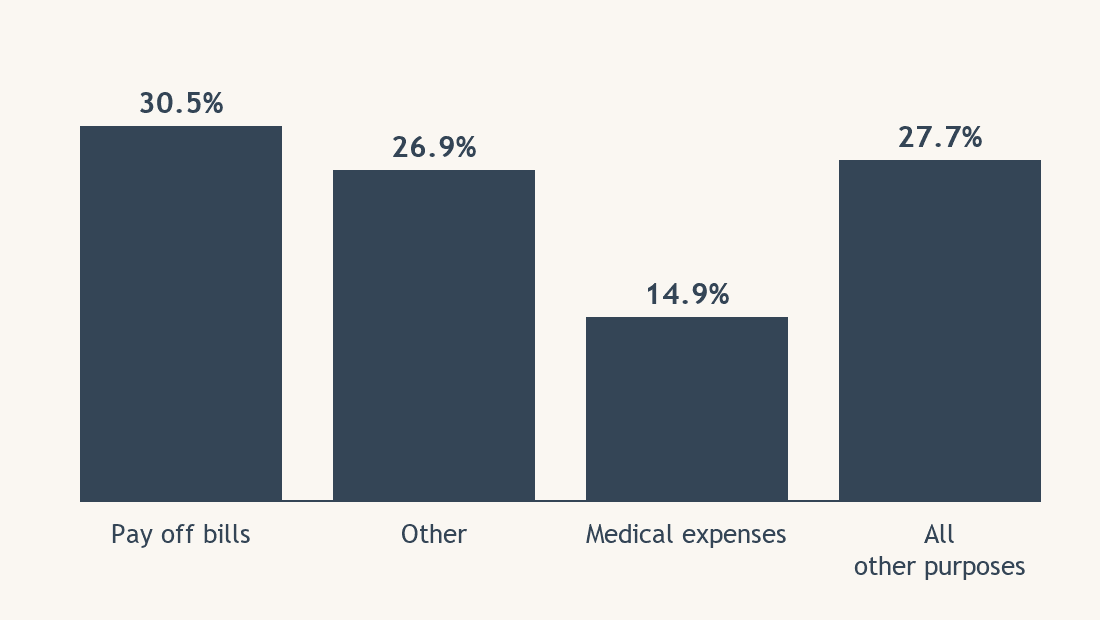
| Stated purpose | Share of applications declaring disability income |
|---|---|
| Pay off bills | 30.5% |
| Other | 26.9% |
| Medical expenses | 14.9% |
| All other purposes | 27.7% |
The pattern is a bill, a medical cost, or something the form's categories do not name. Medical expenses at 14.9% is the highest share for that purpose of any income type on our platform, which fits: dental work, mobility equipment, prescriptions and travel to appointments are the costs a disability income most often cannot absorb in one month.
The amounts are modest by design. $1,388 on average, against $5,888 across all personal applications, and against a stated monthly income of $2,820. Most people on disability income who apply here are borrowing about half a month's income, not multiples of it.
Credit on these files is thin rather than bad. Of applications declaring disability income, 39.9% carried a fair score, 30.9% poor, 26.6% no usable score, and 2.2% good. A lender that declines on score alone would decline nearly everyone in this group; the lenders on this page do not work that way.
| Credit band, applicants declaring disability income | Share |
|---|---|
| Fair (560 to 659) | 39.9% |
| Poor (under 560) | 30.9% |
| No usable score | 26.6% |
| Good (660 to 724) | 2.2% |
Source: Smarter Loans platform data, applications declaring disability income, January 2026 to June 2026. Shares of 5,582 applications; the great band is suppressed below the reporting floor.
The rate matters less than whether the payment fits the month, and on a fixed income the month does not flex.
Take the average request on this page, rounded to $1,400, over twelve months. At 29.99% APR the payment is about $137 a month and the total interest about $239. At the 35% federal cap it is about $140 a month and $280 in interest. Against a stated income of $2,820 a month, either payment is about 5% of income, which most budgets can carry. Stretch the same $1,400 to $5,000 and the payment more than triples, which is where fixed-income budgets break.
Two things follow. Borrow the amount the need requires and no more. And compare the payment to your monthly income before the rate, because a loan you can carry at 34.99% is better than one you cannot at 19.99%. The personal loan calculator runs any amount, rate and term; the budget calculator shows what is left after the payment.
Every lender on this page is subject to the 35% federal cap on instalment loans, and the smallest advances from fee-priced lenders start at 0% interest. No lender here charges above the cap.
Nineteen lenders offer personal loans here, from $15 on the smallest advances to $35,000 unsecured, and more where a loan is secured against a vehicle or home. Income floors on this page run from $1,000 to $2,500 a month from any regular source, most commonly $1,500; disability income that clears the floor on its own, or with another income on the file, meets it.
The criteria block on this page counts the lenders that name disability income in their published criteria, and today that count is one. That is not the number that will consider your application; it is the number that has written the policy down. The honest guidance is to apply once, state your income source accurately, and let the application route to the lenders whose criteria your file meets. If your credit history is the larger concern, the bad credit loans page explains how lenders here weigh it, and the Financial Consumer Agency of Canada explains how to check your report for free.
All personal loan options are on the personal loans hub. If the income on your file is the Canada Child Benefit rather than disability income, the child tax benefit loans page covers a different assessment. We record disability income as one type and cannot separate CPP Disability, provincial support and private benefits; the figures cover all three together.
Source for all platform figures on this page: Smarter Loans personal loan applications, January 2026 to June 2026.
Reviewed by Rafael Rositsan, Co-Founder and CEO, Smarter Loans. Last reviewed 6 September 2026. Platform figures cover applications from 1 January to 30 June 2026.

Disability Loans in Canada
How Canadians on ODSP, AISH or CPP Disability actually qualify for loans: which income counts, realistic amounts, benefit interactions, and the alternatives to check first.
What Canadians Ask For When They Borrow Small
71 percent of more than 79,000 Smarter Loans personal loan applications in the year to July 2026 asked for $1,500 or less. The average request in that range was $552, and it barely moves across income types or provinces.

CCB Loans in Canada: How Child Benefit Loans Work
How loans that count the Canada Child Benefit as income work, which lenders accept it, what they cost, and what to check before borrowing.
Emergency Loans in Canada: How to Get Fast Cash When You Need It
What to check before taking a fast loan in Canada: the no-cost options, what the speed really costs, and how to spot a loan…
Yes, where the disability income is regular and paid into your account. In the first half of 2026, 5,582 applicants on our platform declared disability income, 13.1% of all personal applications, and asked for $1,388 on average. Lenders on this page read bank statements for regular deposits; CPP Disability, provincial disability support and private long-term disability benefits all qualify on that basis with lenders that count income from any regular source.
With lenders that count income from any regular source, yes; they arrive monthly on a fixed date, which is what those lenders read for. Income floors on this page run from $1,000 to $2,500 a month from any regular source, most commonly $1,500. One names disability income in its published criteria; several others consider it without naming it.
Lenders on this page offer from $15 on the smallest advances to $35,000 unsecured. In practice the average request from applicants declaring disability income was $1,388 in the first half of 2026, about half a month's stated income of $2,820. The amount that fits is the one whose monthly payment fits the month, and on a fixed income that is the number to check first.
Rates on this page run from 0% on the smallest fee-priced advances to the 35% federal cap on instalment loans, and no lender here charges above the cap. On the average request of about $1,400 over twelve months, the difference between 29.99% and 35% is about $3 a month and $40 in total interest. The payment's fit against your monthly income matters more than the rate.
No. Of applications declaring disability income on our platform, 39.9% carried a fair score, 30.9% poor and 26.6% no usable score at all; only 2.2% were good. Lenders on this page assess the regularity of deposits and the fit of the payment before the score. A score sets the rate within a lender's range rather than deciding the application.