One application. 19 lenders from our 50+ network. Funded in 24 to 48 hours.
Apply Now One application routed to where you qualify.
Every Apply button starts the same single application. Your chosen lender is prioritized first.


















Yes, and on this page every lender accepts self-employed income. All nineteen assess an application from a freelancer, a contractor or a gig worker on the same basis as one from an employee: regular deposits, a modest amount, and what is already leaving the account.
The reason this page exists is not that the income is a problem. It is that the paperwork is. A pay stub proves income in one page; self-employed income proves itself over months of bank statements, and a lender that reads statements is the one to apply to.
Self-employed applicants stated the highest monthly income of any income type on Smarter Loans in the first half of 2026.
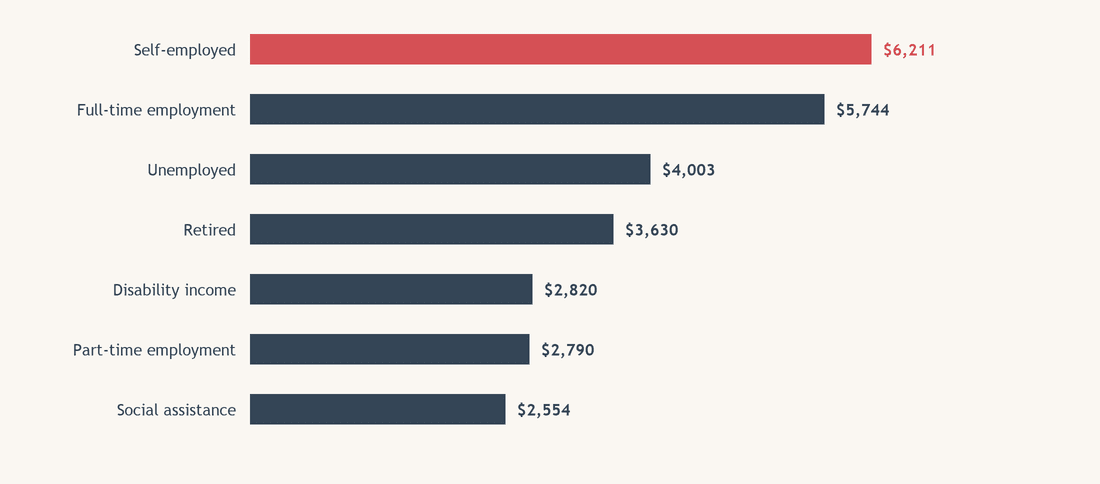
| Income type | Average stated monthly income |
|---|---|
| Self-employed | $6,211 |
| Full-time employment | $5,744 |
| Unemployed | $4,003 |
| Retired | $3,630 |
| Disability income | $2,820 |
| Part-time employment | $2,790 |
| Social assistance | $2,554 |
1,912 applicants declared self-employment as their income type, 4.5% of personal applications, and asked for $3,597 on average, well below the $5,888 average across all personal applications. Higher income, smaller request. On the numbers, self-employed applicants are among the stronger files on the platform.
What they borrow for looks like everyone else: paying off bills on 32.3% of applications, debt consolidation on 7.8%, and 22.5% for purposes the form does not name, which for a freelancer is often the gap between an invoice going out and the money coming in.
Of applicants declaring self-employment, 31.6% carried no usable credit score, the highest share of any income type on the platform. Another 24.9% were poor and 39.0% fair; good and great scores were too few to report.
That is not because freelancers are worse with money. It is because the things that build a score, a salary hitting the same account for years and a credit card paid from it, are exactly the things variable income makes irregular. A freelancer with $6,000 a month and a thin file is a common combination, and it is the combination a bank's scorecard handles worst.
The lenders on this page handle it by reading deposits. Twelve monthly invoices of $5,000 read as $5,000 a month; three quarterly payments of $20,000 read as lumpy, even though the total is the same. If your income arrives in large irregular payments, the single most useful thing you can do before applying is to have six months of statements that show the pattern, so the lender can see the annual figure behind the variability.
Two habits make a self-employed file read well over time, and neither costs anything. Run the business through one account and pay yourself from it on a fixed day, so the personal account shows a salary-shaped deposit even when the business income is lumpy. And keep a small credit facility active and paid in full each month, so the bureau has something to score. A freelancer who does both for a year usually stops needing this page and can borrow at a bank.
A large share of searches that land here are from drivers, and the assessment is the same with one wrinkle: platform payouts arrive weekly or daily and are easy to read, which helps, but they arrive net of the platform's cut and before vehicle costs, which a lender knows.
A driver's file reads best with the payout statements from the platform alongside the bank statements, and with vehicle financing, insurance and fuel visible as regular debits so the lender can net them against the deposits. A driver clearing $1,500 a month after those costs meets most income floors on this page. One clearing $1,500 before them may not, and it is better to know which you are before applying.
What lenders on this page accept, in roughly the order they weight it:
None of this needs to be assembled before the application; it is what a lender asks for after. Having the first two ready saves the days in between.
Rates on this page run from 0% on the smallest fee-priced advances to the 35% federal cap on instalment loans, and no lender here charges above the cap. Amounts run from $15 to $35,000 unsecured. Income floors on this page run from $1,000 to $2,500 a month from any regular source, most commonly $1,500, and self-employment is a regular source when the statements show it.
On the average self-employed request, rounded to $3,600 over eighteen months, a rate of 24.99% APR means a payment of about $242 a month and roughly $750 in interest. Variable income argues for a shorter term than you can comfortably carry in a strong month, since the payment is fixed and the income is not. The personal loan calculator runs any amount, rate and term; the budget calculator is worth running against your slowest month rather than your average one.
A personal line of credit suits variable income better than a term loan for recurring gaps, since you draw in the thin month and repay in the strong one; our guide to personal loan versus line of credit covers the trade. If the borrowing is for the business rather than for you, the business loans hub lists products assessed on business revenue instead.
All personal loan options are on the personal loans hub. If credit history rather than documentation is the larger concern, the bad credit loans page covers how lenders here weigh it. Self-employed is one income type in our data; gig, contract and freelance income are not separated.
Source for all platform figures on this page: Smarter Loans personal loan applications, January 2026 to June 2026.
Reviewed by Rafael Rositsan, Co-Founder and CEO, Smarter Loans. Last reviewed 6 September 2026. Platform figures cover applications from 1 January to 30 June 2026.
Yes. All nineteen lenders on this page accept self-employed income, assessed from bank statements rather than a pay stub. Self-employed applicants on our platform stated the highest monthly income of any income type in the first half of 2026, $6,211, and asked for $3,597 on average. The application turns on six months of statements showing a deposit pattern, not on an employer's letter.
Yes, on the same basis as any self-employed applicant. Platform payouts are easy for a lender to read; what matters is what is left after vehicle costs, which the lender nets against the deposits. A driver clearing $1,500 a month after fuel, insurance and vehicle payments meets most income floors on this page.
Six to twelve months of bank statements first, then your most recent Notice of Assessment from the CRA, then contracts, invoices or platform payout statements where the deposits alone do not show who is paying. For larger amounts a lender may ask for a T1 with the self-employment schedule. None of it needs to be assembled before applying.
Usually the file, not the income. Of self-employed applicants on our platform, 31.6% carried no usable credit score and a further 24.9% were poor, because variable income makes the things that build a score irregular. Lenders on this page read deposits before the score, which is why a thin file with $6,000 a month in deposits is a workable application here and a hard one at a bank.
Often, for a recurring gap. A line lets you draw in a thin month and repay in a strong one, paying interest only on what is drawn, while a term loan fixes the payment whether the month was good or not. For a single known expense, a term loan over a short term is cheaper. Six of the nineteen lenders on this page offer a personal line of credit.