One application. 7 lenders from our 50+ network. Funded in 24 to 48 hours.
Apply Now One application routed to where you qualify.
Every Apply button starts the same single application. Your chosen lender is prioritized first.






| Line of credit | Instalment loan | Payday loan | |
|---|---|---|---|
| Rate range | 19.8 - 34.99% APR | 5.98 - 35% APR | $14 per $100 |
| Interest charged on | Only what you draw | The full amount from day one | Flat fee per $100 borrowed |
| Repayment | Revolving, minimum payment | Fixed instalments, set end date | Due in full on your next payday |
| Re-borrow without reapplying | Yes | No | No, and rollovers are banned in most provinces |
| Best when | Costs arrive over time and you cannot size them yet | You know the amount and want a payoff date | A small shortfall you can clear from your next cheque |
| Watch out for | No end date means a balance can persist for years | Interest on funds you may not need | The highest cost per dollar of any form on this site |
| Term | Monthly payment | Total interest |
|---|---|---|
| 2 years | $546 | $3,099 |
| 3 years | $410 | $4,773 |
| 5 years | $308 | $8,463 |
A personal line of credit is a limit you are approved to borrow up to, not a sum you receive. You draw what you need when you need it, interest runs only on the drawn balance, and the limit refreshes as you repay. There is no fixed term and, unless you set one, no fixed payoff date.
That makes it the opposite of an instalment loan on every point that matters. A loan hands you a sum, charges interest on all of it from day one, and forces the balance to zero on a schedule. A line charges only for what is out, and forces nothing.
Seven lenders on this page offer a personal line of credit, with limits from $15 to $20,000, from 0% APR. Every one of them is subject to the 35% federal cap.
The structure decides the cost more than the rate does, and a worked example shows why a line wins for short recurring gaps and loses for standing balances.
Draw $2,000 and hold it for three months at 19.99% APR. Interest is about $100, and it stops when you repay.
The same $2,000 as a twelve-month instalment loan at 19.99% costs about $185 a month and about $223 in interest, because you carry the full balance from day one and pay it down on a schedule whether you needed it that long or not.
That is the case for a line: for a gap that closes in weeks, it is the cheapest structure available. The case against it is the same arithmetic run the other way. Carry the $2,000 at the minimum payment for three years and the interest passes what any instalment loan would have charged, because nothing forced it to zero. The personal loan calculator prices any amount over any term; our guide to personal loan versus line of credit covers the trade in detail.
The limit follows your deposits and your existing commitments, not the amount you ask for. Lines generally open smaller than an equivalent loan approval and increase with demonstrated use and clean repayment. Asking for $10,000 on $2,500 a month of deposits gets you a smaller line, not a decline.
Two things about a line that a loan does not do. The lender can reduce or withdraw the limit. Revolving facilities are reviewed, and a review after a run of late payments or a change in deposits can cut the limit when you most need it. A line is one contingency, not the only one. An unused line may carry a fee. Some lenders here charge an annual or inactivity fee; most do not. Read the fee schedule before signing, because an unused line is only free if the schedule says so.
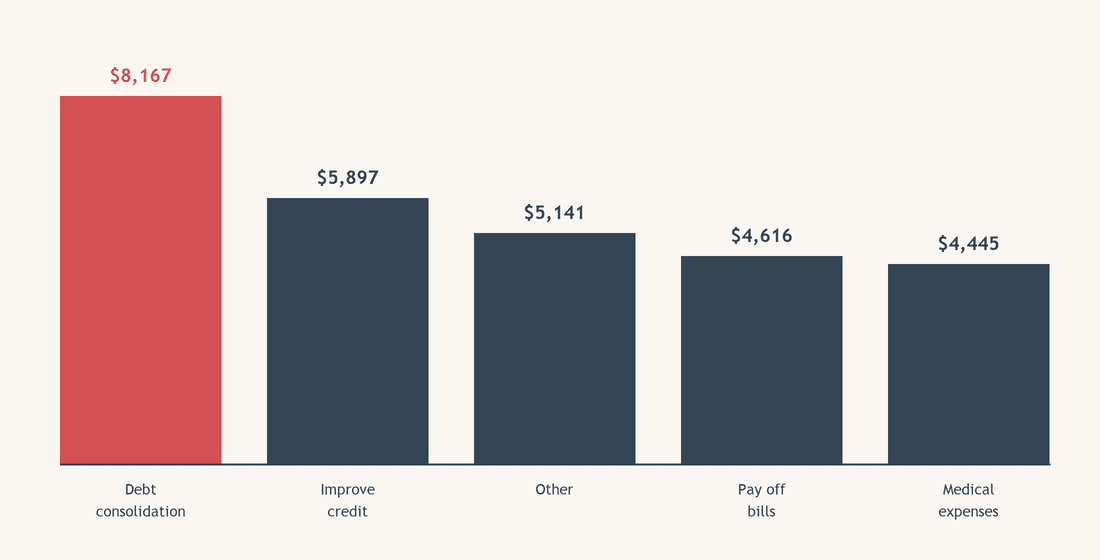
| Stated purpose | Share of personal applications | Average request |
|---|---|---|
| Pay off bills | 33.0% | $4,616 |
| Debt consolidation | 20.5% | $8,167 |
| Other | 17.9% | $5,141 |
| Medical expenses | 5.8% | $4,445 |
| Improve credit | 4.6% | $5,897 |
On Smarter Loans, from January 2026 to June 2026, paying off bills was the stated purpose on 33.0% of personal applications and averaged $4,616; the average across all purposes was $5,888. We do not record which product an applicant ends up with, so the table is for all personal applications rather than lines specifically, but it shows the shape of the need. Bills and gaps are line-shaped: they recur, they vary, and they close. Consolidation, the largest purpose by amount, is loan-shaped: a known sum with a known end, which is what the debt consolidation page covers.
The rule of thumb: if you can name the amount and the date it is gone, take a loan; if you cannot, a line fits.
One further distinction worth making. A line is not an emergency fund, though it is often used as one. An emergency fund costs nothing to hold and nothing to use; a line costs nothing to hold, with most lenders here, and costs interest from the first day it is used. For a household with no savings, a line is the second-best contingency; for one with some, it is the thing you draw on after the savings, not instead of them.
Lines are harder to get than loans with a damaged file, because a revolving facility is an ongoing commitment by the lender rather than a one-time one. Four of the seven lenders on this page will consider a poor score; the rest ask for a fair score or better.
On our platform in the first half of 2026, 46.3% of personal applicants carried a fair score, 23.6% poor and 22.1% no usable score. A line on a poor file, where available, opens with a small limit near the top of the lender's range and grows with clean use. That is the point of it for a rebuilding borrower: a revolving account paid on time every month is one of the strongest signals a bureau reads. The bad credit loans page covers how lenders here assess the file, and the credit building loans page covers products built for exactly that purpose.
A large share of searches for a line of credit are for a specific bank's product, and that is the right first stop if you qualify. Bank lines are cheaper, larger, and assessed on income and credit over days or weeks. The lines on this page are assessed on bank deposits, opened in days, and priced higher for all of that. They exist for the borrower the bank has not said yes to, and for the borrower who needs the limit this week rather than next month.
Many people hold both eventually: an online line first, a bank line once twelve months of clean revolving history exists. What is wrong is carrying a standing balance at online-lender rates that a bank would have carried for less. The Financial Consumer Agency of Canada explains how lines of credit work in general terms; for a business rather than a personal facility, the business line of credit page covers a different assessment.
All personal loan options are on the personal loans hub; the instalment loans page covers the fixed alternative, and the budget calculator shows what a drawn balance leaves in the month.
Source for all platform figures on this page: Smarter Loans personal loan applications, January 2026 to June 2026.
Reviewed by Rafael Rositsan, Co-Founder and CEO, Smarter Loans. Last reviewed 8 September 2026. Platform figures cover applications from 1 January to 30 June 2026.

How to Use a Line of Credit in Canada
How a line of credit works, how much you can get, what it costs while a balance sits, and the discipline that keeps it…
Personal Loan vs Line of Credit: Which Should You Choose?
The real difference between a personal loan and a line of credit, which suits which situation, and what the same borrowing costs on each.
HELOC Strategies Canadians Use, and What They Risk
How Canadians borrow against home equity to invest, consolidate or hold liquidity, what each approach costs, and where the risk sits.
A limit you are approved to borrow up to, drawn as needed, with interest charged only on the drawn balance and the limit refreshing as you repay. There is no fixed term and no forced payoff, which makes it cheap for short recurring gaps and expensive for standing balances. It is the opposite of an instalment loan on every point that matters.
For a gap that closes in weeks, yes, by a wide margin: $2,000 drawn for three months at 19.99% costs about $100, against about $223 for the same $2,000 as a twelve-month instalment loan. For a balance carried for years at the minimum payment, no, because nothing forces a line to zero. The structure decides the cost more than the rate.
Four of the seven lenders on this page will consider a poor score; the rest ask for a fair score or better, because a revolving facility is an ongoing commitment rather than a one-time one. Where a line is available on a poor file it opens with a small limit near the top of the lender's range and grows with clean use, which is itself one of the strongest signals a credit bureau reads.
By your deposits and existing commitments, not by the amount you ask for. Lines open smaller than an equivalent loan approval and increase with demonstrated use and clean repayment. The lender can also reduce or withdraw the limit at review, which is the main risk of relying on a line as your only contingency.
Sometimes. Interest runs only on the drawn balance, but some lenders charge an annual or inactivity fee on an open line. Read the fee schedule before signing; an unused line is only free if the schedule says so.