One application. 10 lenders from our 50+ network. Funded in 24 to 48 hours.
Apply Now One application routed to where you qualify.
Every Apply button starts the same single application. Your chosen lender is prioritized first.









Same day describes three different events, and a lender's page rarely says which.
A same-day decision means the application is assessed inside the business day. Lenders on this page that read bank statements by secure link decide in minutes; lenders that ask for uploaded documents decide once someone has read them.
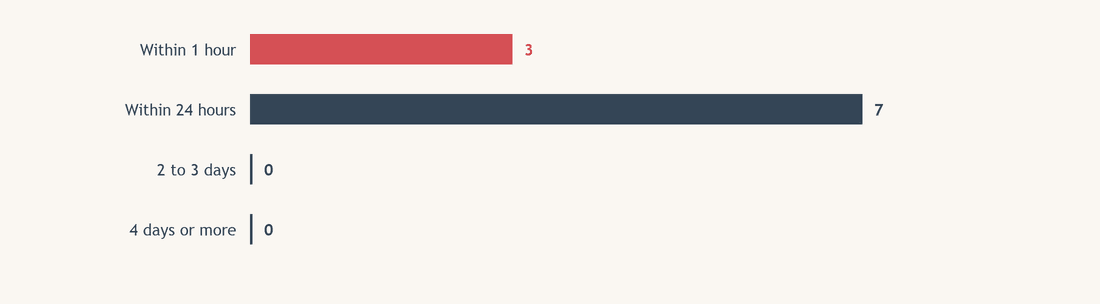
A same-day deposit means the money leaves the lender the same business day the loan is approved and signed. Ten of the ten lenders on this page publish funding within 24 hours, and three publish it within an hour.
Same-day money in your account depends on the last step, which no lender controls: your bank's e-transfer cutoff and clearing. An Interac e-transfer sent at 2 p.m. lands in minutes; one sent after the cutoff lands the next morning. A direct deposit takes a business day whatever the lender did.
The honest reading of "same day" is therefore: apply early in the day, on a bank-linked application, and the money is usually there by evening. Apply at 7 p.m. on a Friday and it is Monday.
| Published funding speed | Lenders on this page |
|---|---|
| Within 1 hour | 3 |
| Within 24 hours | 7 |
| 2 to 3 days | 0 |
| 4 days or more | 0 |
Source: lender published funding speeds, reviewed August 2026. The slowest published speed on this page is 1 day.
Every figure in that table is what the lender publishes, not what we have observed. The ones within an hour are the fee-priced small advances and the fastest instalment lenders; the multi-day ones are lenders that verify documents by hand, which is slower and, for some files, more likely to say yes.
Speed is priced in two ways on this page, and only one of them costs more.
The first is the product. The fastest money here is the small fee-priced advance: a few hundred dollars, a fee per $100 borrowed, due in full from the next deposit. A $500 advance at $15 per $100 for fourteen days costs $75, which annualises far above any instalment rate on this page. The Financial Consumer Agency of Canada's payday loan guidance sets out how those fees work and the provincial caps.
The second is the application method, and it costs nothing. An instalment lender that reads your bank statements by secure link decides as fast as a payday lender and prices from 0% APR up to the 35% federal cap. The same $500 over three months at 29.99% costs about $25 in interest. Same day, a third of the cost; the difference is that you gave the lender a statement link instead of a pay stub.
The test: if the money is needed today and will be repaid from the next deposit, the advance is the product; if it will take more than one pay period to clear, the instalment loan is cheaper by a wide margin, and just as fast on a bank-linked application. The personal loan calculator prices any amount over any term.
On Smarter Loans, from January 2026 to June 2026, more than 28,000 applications were for under $1,500, averaging $493. Paying off bills was the stated purpose on 37.4% of them, medical expenses on 12.4%, moving on 4.8%. That is the population of this page: a specific bill, a specific date, and a need for the money before it. Only 2.5% of those applicants carried a good credit score; 41.3% were fair, 30.2% poor and 25.7% had no usable score. We cannot see how long any application took to fund, so the funding speeds on this page are the lenders' published figures rather than observed ones.
Lenders here read that file the same way regardless of speed: deposits first, then what is already leaving the account, then the score. Income floors on this page run from $1,000 to $2,500 a month from any regular source, most commonly $1,500. Eight of the ten will consider a poor score.
Almost everything that delays a same-day loan is on the applicant's side, and all of it is avoidable.
Less than most people fear, and in a way you control. Most lenders on this page begin with a soft inquiry, which reads your file without leaving a mark, and decide on the bank statements. A hard inquiry, which does leave a mark, usually comes only at the point of a firm offer, and one hard inquiry costs a handful of points for a few months.
What costs more is the pattern that speed tempts: applying to five lenders in an afternoon to see who is fastest. Each one that runs a hard inquiry leaves its own mark, and a lender reading a file with four fresh inquiries reads a borrower who was declined four times, whether or not that is true. One application routed to the lender most likely to say yes is faster in practice and cheaper on the file.
A same-day loan repaid on time from a lender that reports to the bureaus is, in the other direction, one of the quickest small positive entries a thin file can get.
If the need is a few hundred dollars for two weeks, the payday loans page shows the provincial caps. If it is an unplanned cost rather than a timing gap, the emergency loans page covers how to size it. All personal loan options are on the personal loans hub.
Source for all platform figures on this page: Smarter Loans personal loan applications, January 2026 to June 2026.
Reviewed by Vlad Sherbatov, Co-Founder and President, Smarter Loans. Last reviewed 8 September 2026. Platform figures cover applications from 1 January to 30 June 2026.
Yes, from lenders that assess bank statements by secure link and pay by e-transfer. Ten of the ten lenders on this page publish funding within 24 hours and three within an hour. The last step is your bank's e-transfer cutoff, which no lender controls, so applying before noon on a weekday is most of what "same day" requires.
Only if you choose the fast product rather than the fast method. A fee-priced advance of $500 at $15 per $100 for fourteen days costs $75; the same $500 over three months at 29.99% APR costs about $25. An instalment lender reading a bank link decides just as fast, so speed itself is free; the advance is what costs more.
Uploading statements instead of linking a bank account, a name mismatch between the application and the account, applying after your bank's e-transfer cutoff, and applying to several lenders at once. Each moves the file from an automated decision to a human one.
Eight of the ten lenders on this page will consider a poor score, and speed does not depend on the score; it depends on the application method. On our platform in the first half of 2026, 30.2% of everyday-scale applicants had a poor score and 25.7% no usable score. A returned payment in the last statement is the more common reason a fast application slows to a human read.
On our platform in the first half of 2026, the average request under $1,500 was $493, and 37.4% of those applications were to pay off a bill. Same-day borrowing is mostly small and specific: a bill with a date. Smaller requests clear faster and cost less.