One application. 10 lenders from our 50+ network. Funded in 24 to 48 hours.
Apply Now One application routed to where you qualify.
Every Apply button starts the same single application. Your chosen lender is prioritized first.









An emergency loan is not a product. It is a small personal loan sized to one unplanned cost, and the word "emergency" describes the borrower's week, not the lender's terms. What makes it different from any other loan on this site is the pressure to decide quickly, and that pressure is where most of the expensive mistakes happen.
Two rules hold across every lender on this page. The amount that fits is the bill, not the fear. And the term that fits is the shortest you can carry, because on a small loan the term sets the cost more than the rate does.
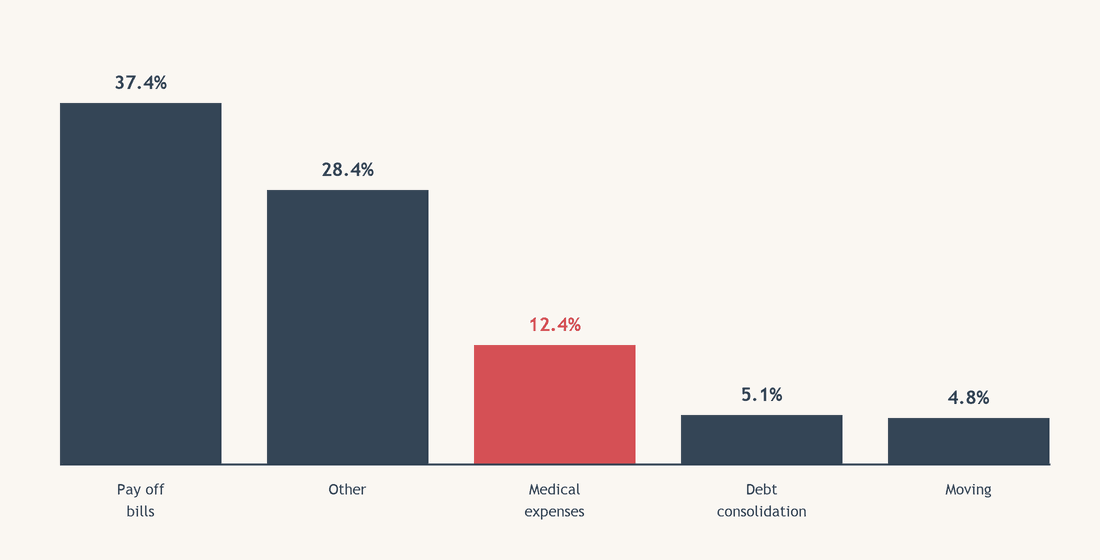
| Stated purpose | Share of everyday-scale applications | Average request |
|---|---|---|
| Pay off bills | 37.4% | $515 |
| Other | 28.4% | $439 |
| Medical expenses | 12.4% | $456 |
| Debt consolidation | 5.1% | $633 |
| Moving | 4.8% | $508 |
On Smarter Loans, from January 2026 to June 2026, more than 28,000 applications were for under $1,500, averaging $493. A bill, a medical cost and something the form does not name account for nearly four in five. We do not record "emergency" as a purpose, so this is the nearest population we can show, and it is a close one: these are the amounts people ask for when something has gone wrong.
Medical expenses at 12.4% is the figure worth pausing on. Dental work, a prescription, a vet, an ambulance bill outside coverage: these are the emergencies Canadians borrow for most after a plain bill, and they average $456. The medical loans page covers that case specifically; a car repair is the other common one.
The single most useful thing to do before applying is to write down the number.
An emergency loan sized to the bill is cheap. One sized to "what if something else goes wrong" is a standing balance at an emergency rate. Take a $600 repair. Borrow $600 over three months at 29.99% APR and the interest is about $30. Borrow $2,000 "to be safe" over twelve months at the same rate and the interest is about $340, plus a year of a payment you did not need. The difference is not the rate; it is the $1,400 of fear.
Then choose the term the same way. On $1,000 at 29.99%, three months costs about $51 in interest, twelve costs about $170, twenty-four costs about $342. A short term on a small amount is the cheapest borrowing on this site. The personal loan calculator prices any amount over any term, and the budget calculator shows whether the payment fits the month.
Ten lenders on this page offer personal loans from $15 to $20,000 unsecured, from 0% APR up to the 35% federal cap on instalment loans. Ten publish funding within 24 hours and three within an hour, which for a real emergency is the figure that matters. Income floors on this page run from $1,000 to $2,500 a month from any regular source, most commonly $1,500. Eight of the ten will consider a poor score.
Speed here comes from the application method rather than the product. A lender that reads your bank statements by secure link decides in minutes; one that asks for uploads decides when a person has read them. On our platform in the first half of 2026, 41.3% of everyday-scale applicants carried a fair score, 30.2% poor and 25.7% no usable score, and lenders on this page are built for that file: deposits first, existing commitments second, the score last.
Every page on this site that covers small borrowing ends up at the same place: a loan is the second-best answer to an emergency, and the best one is money already there.
The arithmetic is blunt. The $30 of interest on a $600 emergency loan is the cost of not having $600. Three of those a year is $90, and a hundred dollars a month set aside would have covered all three by April. The Financial Consumer Agency of Canada's budgeting guidance sets out how to build a savings buffer from a standing start.
That is not a reason not to borrow this week. It is the reason the loan should be sized to this week's bill and cleared fast, so that next month's hundred dollars goes into the fund rather than into interest. A line of credit is the halfway house for a household with no savings yet: it costs nothing to hold with most lenders and is drawn only when something breaks.
An emergency does not wait for a score to recover, and the lenders here know that. Eight of the ten will consider a poor score; all of them read deposits first. What a poor score changes is the rate within a lender's range, not usually the decision, and on a small short loan the rate matters less than the term: the gap between 19.99% and 34.99% on $600 over three months is about $15.
Where the emergency is itself a returned payment or a missed bill, say so on the application. A lender reading the statement will see it anyway, and a file that explains the mark reads better than one that hopes it is missed. The bad credit loans page covers how lenders here weigh the score.
The honest answer belongs on this page, because emergencies come in pairs more often than people plan for.
A missed instalment on a loan from a lender on this page usually means a returned-payment fee at your bank, a late fee from the lender, and a mark on the credit file if it runs past thirty days. What it does not usually mean is a collection or a call to your employer; those are payday-lender behaviours, and this page lists instalment lenders and lines of credit.
The thing that changes the outcome is timing. A lender told three days before the due date that the payment will be short will nearly always move the date or split the payment; a lender told three days after has already sent the debit, paid the fee, and started the clock. If the month is going to be tight, the call before the due date is worth more than any rate on this page.
If the money is needed this afternoon, the same day loans page covers what same-day requires. If the need is a few hundred dollars until the next deposit, the payday loans page shows the provincial caps and why an instalment loan is usually cheaper. All personal loan options are on the personal loans hub.
Source for all platform figures on this page: Smarter Loans personal loan applications, January 2026 to June 2026.
Reviewed by Rafael Rositsan, Co-Founder and CEO, Smarter Loans. Last reviewed 8 September 2026. Platform figures cover applications from 1 January to 30 June 2026.
Emergency Loans in Canada: How to Get Fast Cash When You Need It
What to check before taking a fast loan in Canada: the no-cost options, what the speed really costs, and how to spot a loan…

How to Secure a $3,000 Loan in Canada: Your Complete Guide
How to get a $3,000 loan in Canada, which lenders skip the credit check, what that costs, and how fast each option funds.
Is a Canadian Loan Company Legit? How to Check
How to check whether a Canadian loan company is legitimate: licence registries, the upfront-fee rule, the red flags, and how to verify Smarter Loans.
A small personal loan sized to one unplanned cost. It is not a distinct product; "emergency" describes the week, not the terms. On our platform in the first half of 2026, more than 28,000 applications were for under $1,500, averaging $493, most of them for a bill or a medical cost. The amount that fits is the bill, and the term that fits is the shortest you can carry.
The bill, not a cushion. $600 over three months at 29.99% APR costs about $30 in interest; $2,000 "to be safe" over twelve months at the same rate costs about $340 plus a year of payments. The difference is the money borrowed against something that has not happened.
Ten of the ten lenders on this page publish funding within 24 hours and three within an hour. Speed comes from the application method: a bank link is read in minutes, uploaded statements by a person. Your bank's e-transfer cutoff decides the last step.
Eight of the ten lenders on this page will consider a poor score, and all read deposits before the score. In the first half of 2026, 30.2% of everyday-scale applicants on our platform had a poor score and 25.7% no usable score. On a small short loan the score moves the rate a little and the total cost less: about $15 on $600 over three months between 19.99% and 34.99%.
For a borrower who has a card with room on it and can clear the balance inside a month, the card is cheaper, often free. For a borrower who does not, or who would carry the balance, a short instalment loan with a fixed payoff date usually costs less than a card balance that never quite clears. The rule is to compare the total interest, not the rate.