One application. 14 lenders from our 50+ network. Funded in 24 to 48 hours.
Apply Now One application routed to where you qualify.
Every Apply button starts the same single application. Your chosen lender is prioritized first.













Subprime is the lending industry's word for a borrower below roughly a 660 credit score, and on our platform it is not a niche. On Smarter Loans, from January 2026 to June 2026, 69.9% of personal loan applicants carried a score below 660, and 71.5% at the everyday scale under $1,500. Seven in ten. The lenders on this page did not add a subprime product to their range; subprime is their range.
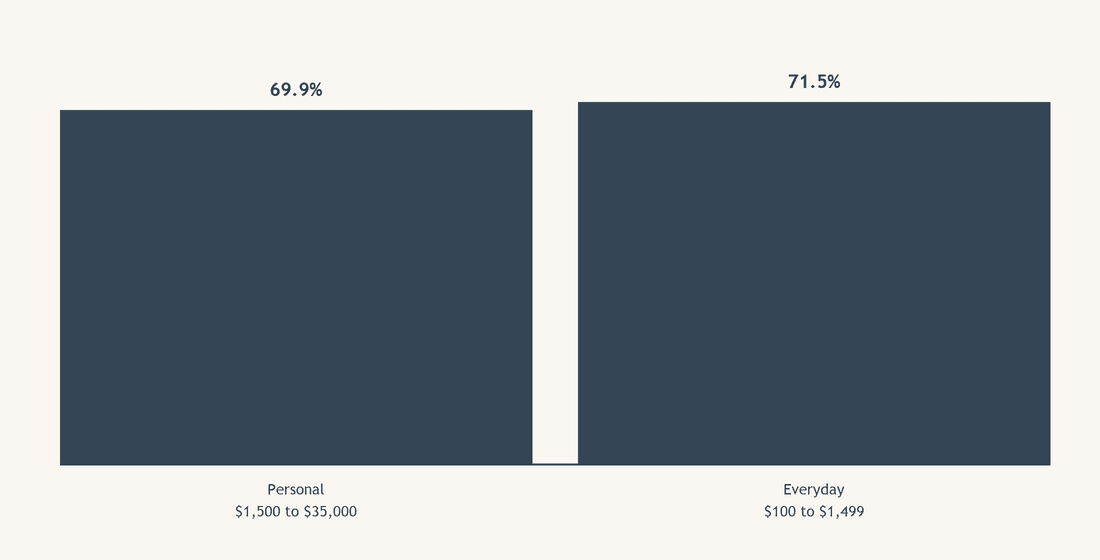
| Scale | Share of applicants below a 660 score |
|---|---|
| Personal, $1,500 to $35,000 | 69.9% |
| Everyday, $100 to $1,499 | 71.5% |
Source: Smarter Loans platform data, January 2026 to June 2026. Below 660 combines the fair and poor bands; the no-score group is excluded from both figures.
Add the applicants with no usable score, 22.1% at the personal scale and 25.7% at the everyday, and fewer than one in ten applicants on this platform is what a bank would call prime. That is the population every page on this site is written for, and this page is the one that says so.
A bank's scorecard treats a score below 660 as a reason to decline. A subprime lender treats it as a reason to price. The difference is the whole business model.
Price, not decision. Fourteen of the fourteen lenders on this page will consider a poor score. What the score sets is where in the lender's range the offer lands; for a subprime file that is usually the top half, and for a poor file often near the 35% federal cap on instalment loans.
Deposits over history. Subprime lenders read bank statements because the credit file is, by definition, not telling them what they need. Three months of regular deposits is worth more to a lender here than the score, and a returned payment in the last statement costs more than a two-year-old collection.
Smaller, shorter, secured or guaranteed. The four ways a subprime lender manages the risk. Smaller amounts, shorter terms, an asset behind the loan, or a second signature. Most subprime lending is the first two.
Reporting. Most lenders on this page report to the bureaus, which is the exit route: a subprime loan repaid on time is how a subprime borrower stops being one.
The rate is the visible cost, and the term is the larger one.
On $3,000 over 24 months, 19.99% APR costs about $664 in interest and 29.99% about $1,025. That $361 is the subprime premium on a typical file. But the same $3,000 over 12 months at 29.99% costs about $510, less than the prime rate over 24. A subprime borrower who borrows short pays less than a prime borrower who borrows long, which is the single most useful fact on this page.
Across personal applications on our platform, requests ran from $4,920 on average for a poor score to $10,963 for a great one; subprime borrowers ask for less and should borrow shorter, and most already do. The personal loan calculator prices any amount at any rate and term; the number to read is total interest, and it falls fastest with the term.
Every lender on this page is subject to the 35% federal criminal rate cap on instalment loans, lowered from the old effective ceiling in 2025. No instalment product on this site is priced above it. Payday loans sit under a separate provincial regime priced as a fee per $100 rather than an APR; the payday loans page shows the caps by province, and they are the one place a subprime borrower can pay more than 35% in effect.
The cap sets the ceiling. What sets your position under it is deposits, existing commitments and the band, in that order. The Financial Consumer Agency of Canada's guide to credit reports and scores explains how to see what a lender sees; errors on a subprime file are common and each one costs points.
The score moves in twelve-month increments, and the route out is the same for everyone.
Pay every account on the day it is due for a year; payment history is the largest factor and the fastest to move. Keep any revolving balance below a third of its limit. Close nothing old. Apply once, not five times. Dispute every error on both reports. And if you borrow, borrow from a lender that reports, on a term you will finish.
A subprime borrower who does that for a year usually crosses 660, and the next loan prices in a different range. Our guide to going from bad credit to over 700 covers the sequence; the credit building loans page covers products built for it; the bad credit loans page covers what to borrow in the meantime.
Not quite, and the difference is useful. Bad credit is a file with negative marks: a missed payment, a collection, a default. Subprime is a score band, and a file can be in it for reasons that have nothing to do with missed payments: a short history, a single high card balance, too many recent inquiries, or a thin file that has never carried enough accounts to score well. On our platform, the fair band alone, 560 to 659, is 46.3% of personal applicants, and a large share of those files carry no negative mark at all. They are subprime by score and clean by history, and a lender reading the statements rather than the number sees the difference. That is the file the lenders here price best, and it is the file that moves out of subprime fastest.
Fourteen lenders on this page offer personal loans from $15 to $35,000 unsecured, from 0% APR up to the 35% federal cap, on terms to 84 months. Income floors on this page run from $1,000 to $2,000 a month from any regular source, with four lenders at each of $1,000, $1,200 and $1,500. Eight publish funding within 24 hours. Every one of them reads deposits before the score, which is the definition of a subprime lender in practice.
We do not publish approval rates by band, so nothing on this page tells you how likely a subprime application is to succeed; what the figures show is who applies and what they ask for.
All personal loan options are on the personal loans hub. Our guide to what score you need for a personal loan sets expectations by band.
Source for all platform figures on this page: Smarter Loans personal loan applications, January 2026 to June 2026.
Reviewed by Vlad Sherbatov, Co-Founder and President, Smarter Loans. Last reviewed 9 September 2026. Platform figures cover applications from 1 January to 30 June 2026.
A loan to a borrower below roughly a 660 credit score, priced for the risk rather than declined for it. On our platform in the first half of 2026, 69.9% of personal loan applicants sat below 660, and 71.5% at the everyday scale; subprime is most of the market the lenders on this page serve, not a niche within it.
Broadly, below 660, which covers the fair band (560 to 659) and the poor band (under 560). Applicants with no usable score are treated separately but priced similarly. Fewer than one in ten applicants on our platform would be called prime by a bank.
On $3,000 over 24 months, about $1,025 in interest at 29.99% APR against about $664 at 19.99%. The same $3,000 over 12 months at 29.99% costs about $510, less than the prime rate over 24, so a subprime borrower who borrows short pays less than a prime borrower who borrows long. Every lender on this page is capped at 35% on instalment loans.
Not with no check at all. Lenders on this page use a soft inquiry that does not affect your score and decide on bank deposits. Any lender advertising no check whatsoever, or guaranteed approval, should be read carefully; those phrases usually sit beside fees due before any money arrives.
Pay every account on the day it is due for a year, keep revolving balances under a third of the limit, close nothing old, apply once rather than repeatedly, dispute errors on both reports, and borrow only from lenders that report, on terms you will finish. Most borrowers who do that cross 660 within a year and price in a different range on the next loan.