One application. 1 lender from our 50+ network. Funded in 24 to 48 hours.
Apply Now One application routed to where you qualify.
Every Apply button starts the same single application. Your chosen lender is prioritized first.
Two products answer the search on this page, and confusing them is the most common mistake in the category.
A credit-builder product is a small account whose purpose is the payment history it creates. The amount is modest, the cost is a fee rather than interest, and the lender reports every payment to the credit bureaus. You are not really borrowing; you are buying twelve months of reported on-time payments. One listed lender on this page offers one: $30 to $250 at 0% interest, with the base account free and the credit-building membership priced at $11.99 a month.
A personal loan taken to improve credit is an ordinary instalment loan whose stated purpose is credit repair. On our platform, from January 2026 to June 2026, improving credit was the stated purpose on 4.6% of personal loan applications, averaging $5,897. An amount that size is not a credit-builder; it is a consolidation, and the debt consolidation page is where its arithmetic lives.
The test: if your file is empty, or thin, or you owe nothing, you need the first product. If your file is damaged and you owe money at high rates, you need the second, and only if the rate beats what you owe.
A score is built from a small number of things, and a credit-builder product is designed to hit the ones a new or thin file lacks.
Payment history. The largest factor. Twelve consecutive on-time payments reported to both bureaus is the single most valuable thing a thin file can acquire, and it is exactly what a credit-builder product produces.
Account age and mix. A reported account that stays open and in good standing ages the file. A revolving account, which is how the product on this page reports, adds a type many thin files lack.
Utilisation. Only revolving accounts carry it. A small limit used lightly and paid in full reads well; a small limit maxed out reads badly, so the product works best used sparingly.
Inquiries. Each hard inquiry costs a little. A file with several fresh inquiries and no history reads as someone who was declined several times. One application, not five.
What does not build a score: paying rent or utilities on time, unless a reporting service is involved; keeping a bank balance; a loan from a lender that does not report. Ask before signing anything whether it reports, and to which bureaus.
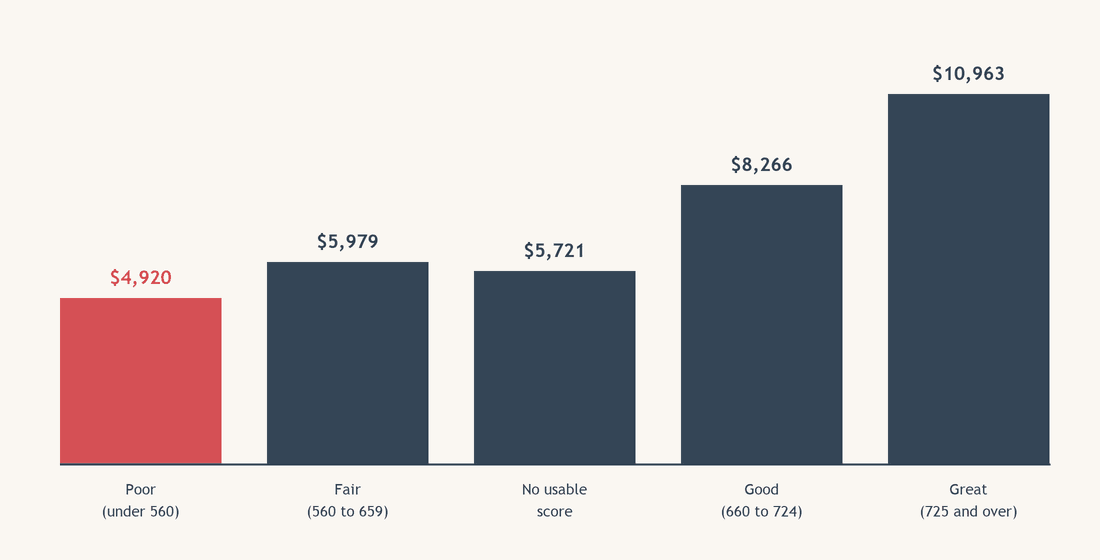
| Credit band | Share of personal applicants | Average request |
|---|---|---|
| Fair (560 to 659) | 46.3% | $5,979 |
| Poor (under 560) | 23.6% | $4,920 |
| No usable score | 22.1% | $5,721 |
| Good (660 to 724) | 6.7% | $8,266 |
| Great (725 and over) | 1.3% | $10,963 |
On Smarter Loans, from January 2026 to June 2026, 22.1% of personal loan applicants carried no usable score at all, and 23.6% carried a poor one. Nearly half of all applicants, in other words, are people for whom the credit-builder question is live. We do not record whether an applicant's file is empty or damaged, only the score band, so the split between the two products on this page is inferred from the band rather than observed.
That the unscored group asked for $5,721 on average, close to the overall $5,888, is worth noticing: an empty file does not push the request down, which is one reason a thin-file borrower is often better served by a small builder product now and a larger loan at a better rate in a year.
The builder product. Twelve months of a $11.99 fee is $143.88. That buys a year of reported payments on a revolving account and nothing else; the money itself is small and is not the point.
A loan used to build. $1,000 over twelve months at 29.99% APR costs about $170 in interest and produces twelve reported instalment payments. It costs more than the builder product and reports a different account type, and if you needed the $1,000 anyway it is the better deal, because the history comes free with the borrowing.
A secured credit card, from a bank rather than this page, costs an annual fee and a deposit you get back, and reports as revolving. Alongside either of the above, it is the second account that turns a file into a score.
The rule: never borrow money you do not need at interest in order to build credit. Use a builder product or a secured card, which cost a fee, and let the history accrue while you spend nothing on interest.
A damaged file and an empty file need different things, and most people on this page have the first.
A damaged file has negative marks that age out on their own schedule; nothing on this page removes them. What a builder product does on a damaged file is add positive history alongside the marks, so that the ratio improves as the marks age. That is slower than on an empty file, and it works. The Financial Consumer Agency of Canada's guide to credit reports and scores explains how to pull both reports free and what to dispute; errors are common, and a corrected error moves a score faster than a year of payments.
Our guide to improving your credit score fast covers the sequence, and the bad credit loans page covers what lenders here lend to a damaged file in the meantime. For a newcomer with no Canadian file at all, the newcomer loans page covers the empty-file case specifically.
Not always. A person with an existing card paid in full each month, a car loan in good standing, or a phone contract reported to the bureaus is already building; a builder product adds a little on top. The product earns its fee in three cases: an empty file, a file with only negative marks and no open positive accounts, and a file thin enough that no bank will open a card. In every other case the cheaper route is the accounts you already hold, paid on the day they are due.
All personal loan options are on the personal loans hub. If you owe money at high rates and the goal is a better score through lower balances, the debt consolidation page covers whether that saves money; our guide to when to use a personal loan covers when not to.
Source for all platform figures on this page: Smarter Loans personal loan applications, January 2026 to June 2026.
Reviewed by Rafael Rositsan, Co-Founder and CEO, Smarter Loans. Last reviewed 9 September 2026. Platform figures cover applications from 1 January to 30 June 2026.

Credit Builder Loans in Canada
How credit builder loans work, the question that decides whether one helps, what people fixing their credit request, and the alternatives worth weighing.

How to Rebuild Credit in Canada
The sequence that rebuilds a Canadian credit score, how long each stage realistically takes, and what people borrowing to fix their credit request.

Is 700 a Good Credit Score in Canada?
Where 700 sits on the Canadian scale, what it gets you approved for and what it does not, and what borrowers in that band…
A small reported account whose purpose is the payment history it creates rather than the money. The amount is modest, the cost is a fee rather than interest, and every payment is reported to the credit bureaus. One listed lender on this page offers one: $30 to $250 at 0% interest with the base account free and credit building priced at $11.99 a month.
Yes, where the lender reports to the bureaus, which most on this site do. Twelve on-time instalment payments is real history. But never borrow money you do not need at interest to build credit; a builder product or a secured card does the same job for a fee. If you need the loan anyway, the history comes free with it.
Twelve consecutive reported on-time payments create a file; a second account, usually a secured card, alongside it creates a score most lenders will read. Within a year a thin-file borrower who does both usually qualifies for a larger loan at a better rate. On our platform, 22.1% of personal applicants had no usable score in the first half of 2026.
It adds positive history alongside the negative marks, so the ratio improves as the marks age on their own schedule. It does not remove them. Pull both reports free first and dispute any errors; a corrected error moves a score faster than a year of payments.
Size and purpose. On our platform, loans stated as being for improving credit averaged $5,897, which is a consolidation rather than a builder. A builder product is small and priced as a fee; a consolidation is a real loan that only helps a score if its rate beats what you owe. Empty or thin file, take the builder; damaged file with balances, run the consolidation arithmetic first.