One application. 11 lenders from our 50+ network. Funded in 24 to 48 hours.
Apply Now One application routed to where you qualify.
Every Apply button starts the same single application. Your chosen lender is prioritized first.










| Instalment loan | Secured loan | Line of credit | |
|---|---|---|---|
| Rate range | 5.98 - 35% APR | 8.99 - 29.9% APR | 19.8 - 34.99% APR |
| Interest charged on | The full amount from day one | The full amount from day one | Only what you draw |
| Repayment | Fixed instalments, set end date | Fixed instalments, set end date | Revolving, minimum payment |
| Re-borrow without reapplying | No | No | Yes |
| Best when | You know the amount and want a payoff date | An asset can back the loan and cut the rate | Costs arrive over time and you cannot size them yet |
| Watch out for | Interest on funds you may not need | The asset is at risk if payments stop | No end date means a balance can persist for years |
| Term | Monthly payment | Total interest |
|---|---|---|
| 2 years | $521 | $2,510 |
| 3 years | $384 | $3,841 |
| 5 years | $279 | $6,741 |
An unsecured loan pledges nothing. No vehicle, no home, no deposit. If you stop paying, the lender has your signature and the courts, not a title deed. That is why it prices higher than a secured loan, why it is faster to arrange, and why the lender reads your bank account so closely: the deposits are the only security it has.
The price of pledging nothing is measurable. $5,000 over 24 months at 24.99% APR unsecured is about $267 a month and about $1,404 in interest. The same $5,000 at 12.99% secured against a vehicle is about $238 a month and about $705 in interest. About $700 of difference for the same money over the same term, and the whole difference is the collateral.
Three things, in order, and every lender on this page reads them the same way.
Deposits. Three months of regular income landing in the account, the same amount on the same date. This is the security. A lender with no asset to fall back on is lending against the next three months of your pay.
What is already leaving. Existing loan payments, an outstanding advance, returned payments. On an unsecured loan the lender is one creditor among several with no priority, so it wants to know how many others there are.
The score. Last, and it sets the rate within the range rather than the decision. On our platform in the first half of 2026, 46.3% of personal applicants carried a fair score, 23.6% poor and 22.1% no usable score; the lenders on this page price across all of it.
What most unsecured loans still carry, and few applicants notice, is a personal guarantee in all but name: the agreement makes you liable in full, and a default reports to the bureaus and can be pursued through the courts. Unsecured does not mean without consequence; it means without a specific asset.
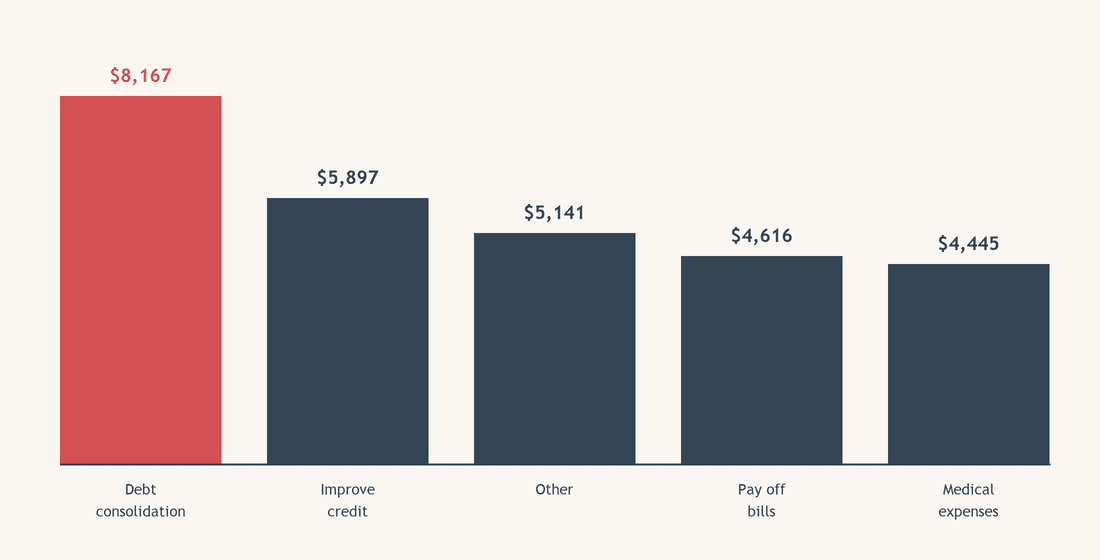
| Stated purpose | Share of personal applications | Average request |
|---|---|---|
| Pay off bills | 33.0% | $4,616 |
| Debt consolidation | 20.5% | $8,167 |
| Other | 17.9% | $5,141 |
| Medical expenses | 5.8% | $4,445 |
| Improve credit | 4.6% | $5,897 |
On Smarter Loans, from January 2026 to June 2026, the average personal loan request was $5,888 across more than 13,000 applications, and every purpose in the table is unsecured by nature: there is no asset behind a bill, a consolidation or a medical cost. That is why unsecured lending is the default in personal finance rather than the exception. We do not record whether an applicant ends up with a secured or unsecured product, so the table covers all personal applications.
The rule: secure the loan only when the asset outlives the loan.
A vehicle financed over five years against itself, a home renovation against the home, a boat against the boat. Those are secured loans that make sense, because the thing pledged is still there at the end and the rate is lower for the whole term. The auto loans hub and the home equity hub cover the two common cases, and the secured loans page covers pledging a vehicle you already own.
Securing a loan for a bill, a wedding or a consolidation against a car you need to get to work is the reverse: the asset is gone from your control the day you miss a payment, for a debt that had nothing to do with it. The lower rate is real; so is the car. For anything that is used up before the loan ends, unsecured is the honest product and the gap in rate is the price of keeping your assets out of it.
Every card on this page is unsecured. The two secured personal products in our network, reaching $75,000, render on the general personal pages instead, where the same application reaches them; they are listed there because they exist, not because they are the recommendation.
Eleven lenders on this page offer unsecured instalment loans from $100 to $35,000, from 9.99% APR up to the 35% federal cap, on terms to 84 months. Income floors on this page run from $1,000 to $2,500 a month from any regular source, with three lenders at each of $1,200 and $1,500. Eight of the eleven will consider a poor score, and five publish funding within 24 hours.
An unsecured loan is faster than a secured one for a reason that has nothing to do with the lender: no asset means no appraisal, no lien registration, no title search. A bank-linked application can be assessed in minutes and funded by e-transfer the same afternoon; a secured loan takes the days the paperwork takes. The Financial Consumer Agency of Canada explains the difference between loans and lines of credit, secured and unsecured, in general terms.
Less than the maximum on the card, and the number comes from your deposits rather than from the lender's range. A lender with no asset behind the loan sizes it to what three months of statements show you can repay from income, and on this page that means a multiple of your monthly deposits rather than a share of something you own. $35,000 is the top of the range here, and it is reached by files with high regular income and clean commitments; an applicant with $2,500 a month in deposits and an existing car payment is sized far below it whatever the card says. Asking for the maximum on that file does not get the maximum; it gets a smaller offer or a decline, and a hard inquiry either way. Ask for the amount the need requires and let the lender size upward if the deposits support it.
Both pledge nothing; the difference is the shape. A loan is a sum on a schedule with an end; a line is a limit drawn as needed with interest on what is out. For a single known amount, the loan; for a recurring gap, the line. The lines of credit page covers the second, and our guide to personal loan versus line of credit covers the trade. Both price above their secured equivalents for the same reason, and the reason does not change with the shape.
All personal loan options are on the personal loans hub. The instalment loans page covers the plain product; the bad credit loans page covers the assessment on a damaged file.
Source for all platform figures on this page: Smarter Loans personal loan applications, January 2026 to June 2026.
Reviewed by Rafael Rositsan, Co-Founder and CEO, Smarter Loans. Last reviewed 9 September 2026. Platform figures cover applications from 1 January to 30 June 2026.
A loan with no asset pledged behind it. The lender relies on your income and your signature rather than a vehicle or a home, prices the risk into the rate, and reads your bank deposits as the security. Eleven lenders on this page offer unsecured instalment loans from $100 to $35,000.
On $5,000 over 24 months, about $1,404 in interest at 24.99% APR unsecured against about $705 at 12.99% secured, roughly $700 for the same money over the same term. The difference is the collateral, and it grows with the term.
When the asset outlives the loan: a vehicle over its own financing, a renovation against the home. For anything used up before the loan ends, a bill, a consolidation, a wedding, unsecured is the honest product, because securing it puts an unrelated asset at risk for a lower rate.
Eight of the eleven lenders on this page will consider a poor score, and all read deposits before the score. On our platform in the first half of 2026, 23.6% of personal applicants had a poor score and 22.1% no usable score. The score sets the rate within a lender's range rather than the decision.
Yes. No asset is taken, but the debt is yours in full, a default reports to the credit bureaus, and the lender can pursue it through the courts. Unsecured means without a specific asset, not without consequence.