One application. 11 lenders from our 50+ network. Funded in 24 to 48 hours.
Get Funded One application routed to where you qualify.
Every Apply button starts the same single application. Your chosen lender is prioritized first.










| Merchant cash advance | Term loan | Line of credit | |
|---|---|---|---|
| Rate range | Factor 1.1 - 1.5 | 2% APR | 7.99% APR |
| Interest charged on | A fixed factor on the advance | The full amount from day one | Only what you draw |
| Repayment | A share of daily card sales | Fixed payments, set end date | Revolving, minimum payment |
| Re-borrow without reapplying | Renewal only | No | Yes |
| Best when | Card revenue is steady but assets are thin | A sized investment with a payback horizon | Cash-flow gaps that come and go |
| Watch out for | Factor pricing costs more than the rate suggests | Prepayment terms differ by lender | No end date means a balance can persist |
A merchant cash advance is not a loan. It is a purchase of your future sales. The provider advances you a sum today and takes an agreed share of your daily or weekly card sales until a fixed total has been repaid. That structure is why everything about it works differently from a loan, and why the eleven providers on this page all price the same way.
It is priced as a factor, not a rate. A factor of 1.3 on $50,000 means you repay $65,000. The $15,000 is the cost, fixed on the day you sign.
Repaying early saves nothing. Because the total is fixed, clearing it in four months costs exactly what clearing it in twelve costs. It just costs it faster.
Repayment moves with your sales. A slow week means a smaller remittance. A strong week means a larger one and a shorter term. This is the one feature that suits some businesses, and it is the same feature that makes the true cost impossible to know until the last payment.
It is not priced or regulated the way a loan is. Because the structure is a purchase of receivables rather than a loan at interest, the rate rules that apply to a business term loan do not map onto it cleanly. Read your agreement rather than assuming anything carries over.
The arithmetic is simple and it is almost never presented.
Advance multiplied by factor equals total repayment. $50,000 at 1.3 repays $65,000. The cost is $15,000, or 30% of the advance.
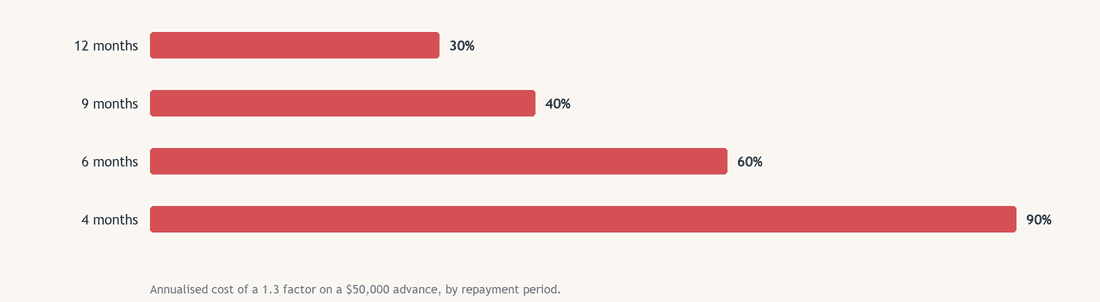
Whether 30% is expensive depends entirely on how long you take to repay it, and that depends on your sales rather than on a schedule you chose.
| Repayment period | Annualised cost of a 1.3 factor |
|---|---|
| 12 months | 30% |
| 9 months | 40% |
| 6 months | 60% |
| 4 months | 90% |
Repaid across twelve months, $15,000 on $50,000 is a 30% annualised cost. Across nine months it is 40%. Across six months, 60%. Across four months, because trade was strong, 90%. The better your sales, the faster you repay, and the more the same $15,000 costs you per year.
This is why we show factor-priced products separately rather than sorting them into an APR list beside term loans. Blending them misrepresents both. The MCA true cost calculator converts any factor and remittance share into an annualised figure against your own sales. We cannot see how long advances actually take to repay; the annualised costs on this page are worked examples, not observed outcomes.
Eleven providers here publish factor pricing from 1.1 to 1.5. Amounts run from $5,000 to $500,000, with one provider capping at $300,000. Terms are short: nine of the eleven publish three to twelve months, and the full range on the page is two to twenty-four.
Minimum monthly revenue. One provider accepts $5,000 a month. Two sit at $8,333, five at $10,000, one at $15,000 and two at $20,000. Since remittance is a share of sales, the floor is also a rough guide to how large an advance each will write.
Time in business. Two providers will look at three months of trading. Seven want six. Two want a full year. [V-f] The two three-month providers sit at opposite ends of the revenue scale, one at $5,000 a month and one at $20,000, so a very young business has a route in at either size. This is the most accommodating product on our platform for a young business, and that is priced in.
Card sales. Most providers here read card processing statements and remit from card receipts. A business whose revenue arrives by invoice or cash is a poor fit for the product and a better fit for working capital loans or invoice factoring.
Owner credit. Matters less here than anywhere else on the site. Revenue-based providers underwrite the sales, and the bad credit business loans page explains what that means in practice.
Advances are written to the same population as the rest of this site: in the first half of 2026, 49.6% of the more than 400 business applicants on our platform carried no usable personal credit score, and 31.1% had been trading under two years.
Availability is national. Provincial pages for Ontario, Alberta and British Columbia list the same providers with any regional detail that applies.
Sometimes it is, and it is worth being precise about when.
Strong, consistent card sales and a short-term opportunity with a return above the cost. A restaurant that can double a weekend's takings with a $20,000 patio build, repaid over a summer, is the textbook case. Our restaurant financing page covers that sector specifically.
A business that cannot yet qualify for term debt, where the alternative is no capital at all. Three months of trading, card-heavy revenue, no statements yet. An advance is often the only product open, and a clean repayment is what qualifies you for a term loan afterwards.
Trade so variable that a fixed payment is itself a risk. Seasonal, weather-dependent or event-driven revenue. Repayment that scales with sales is worth paying for if a fixed schedule would break you in a slow month.
As a substitute for term debt you could qualify for. Almost always more expensive, sometimes by a multiple. If a term lender on our platform will write you the same amount, take it.
To cover an existing advance. A second advance layered on a first is the most common route to a business failing under this product. Two remittances against one revenue stream leaves too little to operate.
When the remittance share leaves too little on a slow week. Model the daily remittance against your thinnest week of the last six months, not your average one. If it does not survive that week, it does not work.
For anything that lasts. A $40,000 hood system bought out of an advance repaid in eight months costs far more than the same hood financed over five years against itself. Durable purchases belong on equipment terms, not on an advance.
| Request size | Share of business demand |
|---|---|
| Under $10,000 | 36.9% |
| $10,000 to $50,000 | 31.9% |
| $50,000 to $150,000 | 17.4% |
| $150,000 to $500,000 | 9.9% |
| $500,000 to $1.5 million | 3.6% |
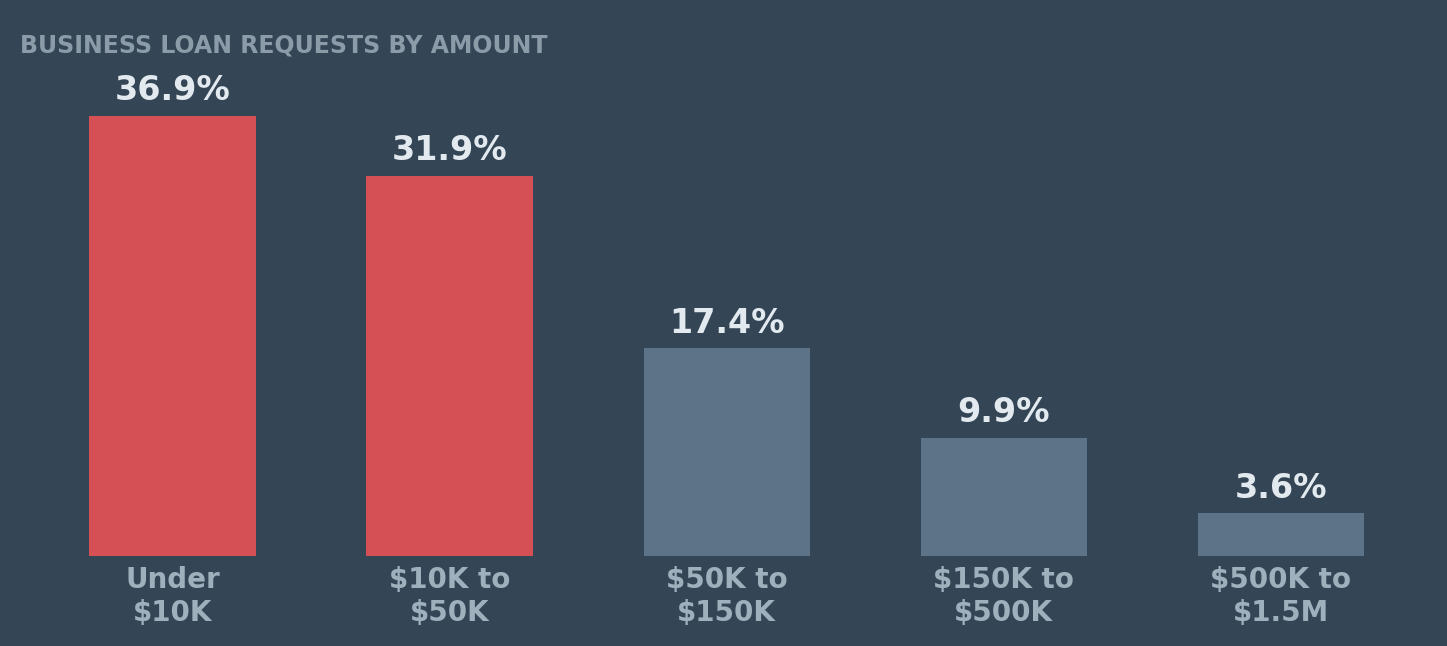
On our platform, 68.8% of business requests are for under $50,000 and everyday operations borrowing averages $89,090. Most advances written here are small, short, and for operating gaps. That is the product working as intended.
This is the question people search for and the one provider websites answer least.
If sales drop, remittances drop with them. That is the design, and it is the product's one real advantage over a fixed payment. The term extends and the total does not change.
Most agreements carry a reconciliation clause. It lets the remittance percentage be adjusted if your sales fall well below the level the advance was priced on. Ask whether yours has one, what triggers it, and who has to initiate it. An agreement without one is a worse agreement.
Nearly every agreement carries a personal guarantee. If remittances stop entirely, the provider can pursue the guarantee. Incorporation does not change that where a guarantee has been signed.
Stopping card processing or moving to a new processor to avoid remittance is usually a breach of the agreement and is the scenario most likely to end in a legal claim. If you are in trouble, call the provider before that point rather than after.
Read the agreement in full before signing. The Criminal Code sets the criminal rate for loans; whether and how it applies to a receivables purchase is a question for the agreement and for a lawyer, not for a provider's sales page.
The business loan calculator prices the same amount as a term loan so you can see the gap. See all business financing options for what else the same application reaches.
Reviewed by Rafael Rositsan, Co-Founder and CEO, Smarter Loans. Last reviewed 3 September 2026. Platform figures cover business loan applications from 1 January to 30 June 2026.
A purchase of your future card sales rather than a loan. The provider advances a sum today and takes a fixed share of daily or weekly sales until an agreed total is repaid. It is priced as a factor, not a rate, the total is fixed on signing, and repaying early saves nothing.
Advance times factor equals total repayment. $50,000 at a factor of 1.3 repays $65,000, so the cost is $15,000. Annualised, that is 30% if repaid over twelve months, 60% over six and 90% over four. Your sales set the period, so the annualised cost is not known until the last remittance.
On this page, minimum monthly revenue runs from $5,000 to $20,000 and minimum time in business from three to twelve months, with six months the most common. Providers read card processing statements and remit from card receipts, so card-heavy revenue matters more than credit score.
You can, but it rarely saves money. The repayment total is fixed at the outset, so clearing it in four months costs the same as clearing it in twelve. A few providers offer a reduced payoff figure for early settlement; ask before you sign, not after.
If sales fall, remittances fall with them and the term extends; most agreements also carry a reconciliation clause that lets the percentage be adjusted, so ask whether yours does. If remittances stop entirely, the provider can pursue the personal guarantee that nearly every agreement carries. Switching processors to avoid remittance is usually a breach. Call the provider before that point.