One application. 13 lenders from our 50+ network. Funded in 24 to 48 hours.
Get Funded One application routed to where you qualify.
Every Apply button starts the same single application. Your chosen lender is prioritized first.












Working capital is the money that keeps a business running between the day you pay for something and the day a customer pays you. A working capital loan covers that gap. It is not growth money, not equipment money, and not a way to keep afloat a business that does not cover its own costs.
That matters because it decides the product. A gap is short and often recurring, so the structure of the borrowing matters more than the rate on it. A term loan, a line of credit, a revenue-based advance and invoice financing all sit under the working capital label, and on the same $25,000 gap they can cost anywhere from a few hundred dollars to several thousand.
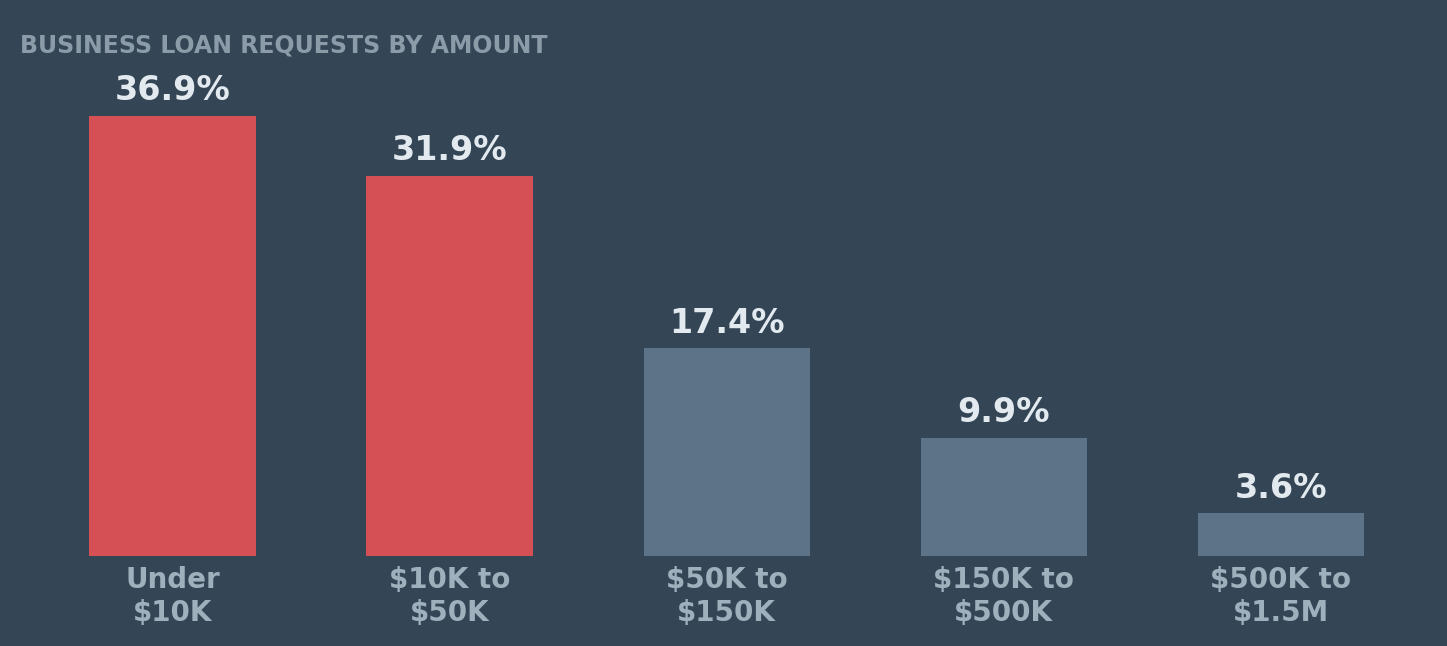
Most Canadian business borrowing is working-capital scale. On Smarter Loans, from January 2026 to June 2026, 68.8% of business loan requests were for under $50,000 and 36.9% for under $10,000. Everyday operations borrowing averaged $89,090 and inventory purchases $78,083, both below the platform's overall business average of $94,465 for the same period. The everyday end of business finance is the biggest end.
The thirteen lenders on this page fall into three groups, and the group decides more than the lender's name does.
Term-loan lenders. A lump sum repaid on a fixed schedule over anything from 2 to 96 months. Published APR floors on term products here run from 7% to 16%. Suits a known one-time gap with a known end date.
Line-of-credit lenders. A limit you draw against, interest on the drawn balance only, limit refreshes as you repay. Three lenders here hold one. Suits a recurring or seasonal gap. The business line of credit page covers how the limit gets set.
Revenue-based lenders. An advance repaid as a share of daily or weekly sales, priced as a factor rather than an interest rate. Three lenders on this page lead with this pricing and most of the others offer it beside their term products. Suits a business whose gap moves with its sales, and costs more than either of the above. The merchant cash advance page works through the arithmetic.
Bank working capital lines sit outside all three: cheaper, larger, secured, and assessed on financial statements over weeks. If you qualify for one, start there. The lenders here are for the business that does not yet, or cannot wait.
Two floors decide most applications on this page, and neither is your credit score.
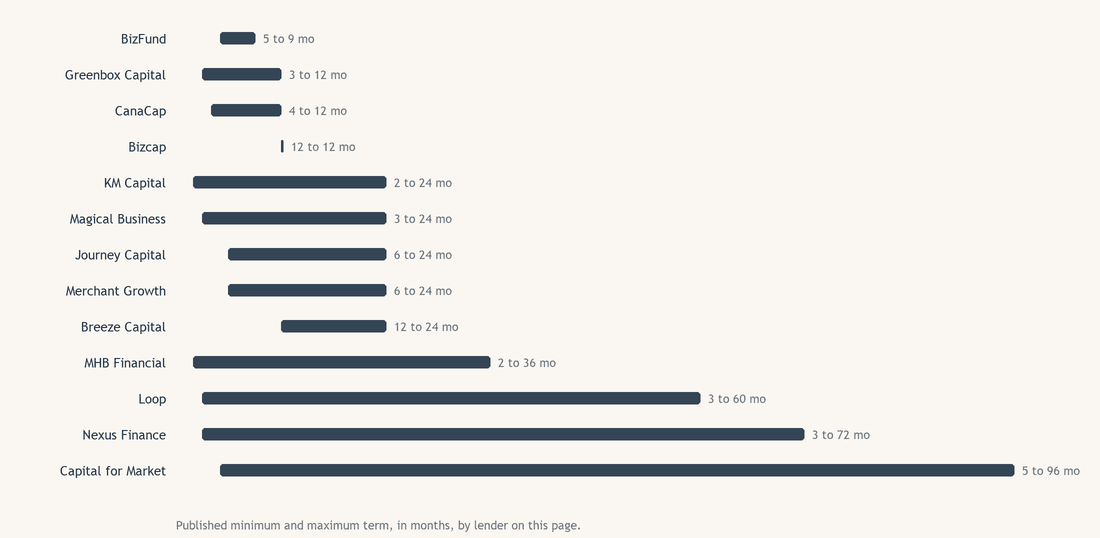
| Lender | Minimum monthly revenue | Minimum months trading | Published term range |
|---|---|---|---|
| Magical Business | $5,000 | 3 | 3 to 24 months |
| MHB Financial | $20,000 | 3 | 2 to 36 months |
| BizFund | $15,000 | 6 | 5 to 9 months |
| KM Capital | $10,000 | 6 | 2 to 24 months |
| Breeze Capital | $10,000 | 6 | 12 to 24 months |
| CanaCap | $10,000 | 6 | 4 to 12 months |
| Journey Capital | $8,333 | 6 | 6 to 24 months |
| Nexus Finance | $10,000 | 6 | 3 to 72 months |
| Greenbox Capital | $10,000 | 6 | 3 to 12 months |
| Bizcap | $20,000 | 12 | 12 months |
| Merchant Growth | $5,000 | 12 | 6 to 24 months |
| Capital for Market | $8,333 | 12 | 5 to 96 months |
| Loop | $10,000 | 12 | 3 to 60 months |
Minimum monthly revenue. Two lenders accept $5,000 a month. Two sit at $8,333, six at $10,000, one at $15,000 and two at $20,000. Clear $10,000 with a steady pattern and most of the page is open.
Time in business. Two lenders will look at three months of trading. Seven want six. Four want a full year. The shorter your history, the more likely the product on offer is revenue-based rather than term.
Deposit pattern. Short-term and revenue-based lenders read your business account directly, and what they are reading for is rhythm. The same amount arriving every week or every month is worth more to them than a larger total that arrives in lumps.
No stacked advances. Every recurring debit in your account is visible to the next lender. Taking a second advance while a first is still remitting is how working capital applications get declined, and how businesses under revenue-based financing get into trouble.
Owner credit sets the rate and the tier rather than the decision. In the first half of 2026, 49.6% of business applicants on our platform had no usable personal credit score and a further 24.4% sat in the fair band. See the bad credit business loans page for what that means.
Name the gap first. Then pick the product.
A single known shortfall with a known end. A large order that needs materials paid for before the customer pays. A term loan, sized to the order, repaid when the receivable lands. Cheapest structure for a one-time gap.
A recurring or seasonal gap. Inventory every autumn, payroll across a thin January. A line of credit. Draw, repay, draw again, interest only on what is out. A term loan for a recurring gap means carrying the whole balance whether you need it or not.
A gap that moves with sales. Variable trade, card-heavy revenue, no appetite for a fixed payment in a slow week. A revenue-based advance. Repayment scales with revenue, which is the point, and the cost is higher, which is the price.
A gap that is entirely timing on invoices already issued. You have done the work, the customer pays in 60 days, payroll is in two weeks. Invoice factoring advances against the invoice and assesses your customer's credit rather than yours.
If you cannot name the gap, that is the finding. Borrowing to cover an undefined shortfall is how working capital turns into stacked advances.
| Request size | Share of business demand |
|---|---|
| Under $10,000 | 36.9% |
| $10,000 to $50,000 | 31.9% |
| $50,000 to $150,000 | 17.4% |
| $150,000 to $500,000 | 9.9% |
| $500,000 to $1.5 million | 3.6% |
Source: Smarter Loans Lending Demand Index, first half 2026.
The average business applying through Smarter Loans has been trading 7.5 years, but 31.1% of applications come from businesses under two years old, and that younger group asked for $82,937 on average against $108,510 for businesses trading five years or more. Businesses reporting $100,000 to $249,000 in annual revenue asked for $49,956.
Only 13.5% of business requests exceed $150,000. Almost everything else is inside what the lenders on this page write, which is why this page carries a working capital lender for nearly every revenue band above $5,000 a month. Working capital is not a product type in our data, so the figures on this page are for all business applications rather than working-capital requests specifically.
Source for all platform figures on this page: Smarter Loans business loan applications, 1 January to 30 June 2026.
Working capital borrowing is worth comparing against what the shortfall itself costs, because the shortfall often costs more.
Supplier early-payment discounts. A supplier offering 2% off for payment within 10 days rather than 30 is offering you 2% for 20 days. Annualised, that is roughly 37%. Borrowing $25,000 at 12% APR for those 20 days costs about $164; the discount is worth $500. Missing it across a year is a real cost, and one most businesses never put a number on.
Missed seasonal inventory. Stock you could not buy in October is margin you do not earn in December. That is lost, not deferred.
Late payroll. Has consequences well beyond the money.
Run the comparison with the business loan calculator. The question is not whether the loan is cheap. It is whether the loan is cheaper than the gap.
Your bank. With two years of reviewed statements, a bank operating line is the cheapest working capital available. Slow, secured, and worth the wait if you can wait.
The Canada Small Business Financing Program. A federal loan-guarantee programme delivered through banks and credit unions. Details at Innovation, Science and Economic Development Canada.
Supplier terms. Thirty extra days from a supplier is working capital that does not appear as debt and does not touch your credit. Worth a phone call before an application.
Collecting faster. Shortening your own payment terms, or offering customers a small discount for early payment, closes the gap from the other side. Our guide to qualifying for a business loan covers what lenders want to see when you do apply.
See all business financing options if the need is not working capital at all. Our guide to secured and unsecured business loans covers what a lender may ask you to pledge.
Reviewed by Vlad Sherbatov, Co-Founder and President, Smarter Loans. Last reviewed 3 September 2026. Platform figures cover business loan applications from 1 January to 30 June 2026.
Short-term financing that covers the gap between paying for something and being paid for it: payroll across a slow month, inventory ahead of a season, a receivable that has not landed. It is not growth money or equipment money. The product that fits depends on whether the gap is one-time, recurring, or moves with your sales.
On this page, minimum monthly revenue runs from $5,000 to $20,000 and minimum time in business from three to twelve months, with $10,000 a month and six months trading the most common floors. Lenders read your business bank account directly, so a steady deposit rhythm and the absence of any stacked advance matter more than your credit score.
For a recurring or seasonal gap, almost always. You draw and repay as receivables land and pay interest only on what is out. For a single known gap with a known end date, a term loan is cheaper and forces a payoff. A term loan for a recurring gap means carrying the full balance whether you need it or not.
Revenue-based lenders that read the bank account directly can fund within a day or two of approval. Term lenders that want financial statements take longer, and bank operating lines take weeks. Speed and cost move together: the fastest money on this page is also the most expensive.
Taking a second advance while a first is still being repaid. Its debits are visible in your account immediately. It is the most common reason a working capital application is declined here, and the most common way a business fails under revenue-based financing: two remittances against one revenue stream leaves too little to operate on.