One application. 12 lenders from our 50+ network. Funded in 24 to 48 hours.
Get Funded One application routed to where you qualify.
Every Apply button starts the same single application. Your chosen lender is prioritized first.











Small business lending in Canada is assessed on bank deposits and time in operation. Somewhere above $500,000 that stops working, because no deposit history supports a raise of that size, and the assessment moves to financial statements. That line is where mid-market financing begins, and everything about the process changes at it.
It is a small part of the market by count. On Smarter Loans, from January 2026 to June 2026, only 13.5% of business loan requests exceeded $150,000, and 3.6% sat between $500,000 and $1.5 million. Businesses trading five years or more asked for $108,510 on average, against $82,937 for businesses under two years old. The average applicant has been trading 7.5 years. Mid-market borrowing is the top of that distribution: established businesses, larger sums, longer processes.
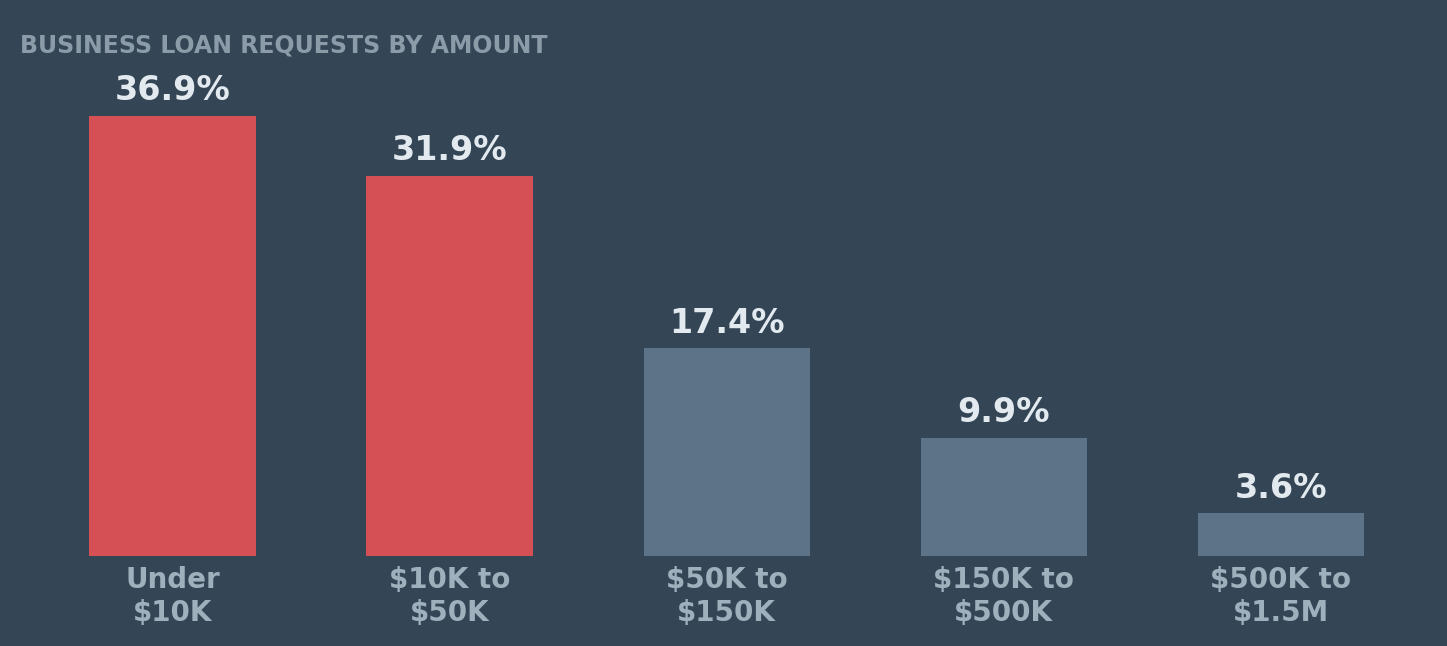
| Request size | Share of business demand |
|---|---|
| Under $10,000 | 36.9% |
| $10,000 to $50,000 | 31.9% |
| $50,000 to $150,000 | 17.4% |
| $150,000 to $500,000 | 9.9% |
| $500,000 to $1.5 million | 3.6% |
Source: Smarter Loans Lending Demand Index, first half 2026.
Twelve lenders on this page write term loans. Seven publish a maximum at or above $1 million and one goes to $50 million. Published APR floors run from 7% and terms run to 96 months. Seven of the twelve accept six months of trading and four want a full year; half sit at $10,000 a month in revenue as a floor. At this size the statements decide far more than the floors do.
The documents. Reviewed or audited financial statements, usually two to three years. Internally prepared statements are rarely enough at this scale, and a lender that accepts them will price the uncertainty in.
Covenants. Ongoing conditions written into the loan agreement: a minimum debt service coverage ratio, a maximum debt-to-equity ratio, a working capital floor, limits on capital expenditure, restrictions on further borrowing or on selling assets, and a requirement to deliver statements within a set period after year end. Breaching one can put the loan in default even when every payment is current. This is the single largest difference from small business lending, and the one most often misunderstood until it bites.
A security package rather than a single pledge. A general security agreement over the business, specific charges over particular assets, often a personal guarantee from the principals, and sometimes an intercreditor agreement where another lender already holds security.
A longer timeline. Due diligence at this scale runs to weeks. A lender reads the statements, may commission an appraisal, and negotiates the covenant schedule before anything is signed.
Ask for the covenant schedule before you sign, and model it against a bad quarter rather than a good one.
The reporting covenant is the one most often breached, and it is breached administratively rather than financially. Missing the deadline to deliver year-end statements is a default in the same technical sense as missing a payment. If your accountant is slow, negotiate the window before signing, not after.
The debt service coverage covenant is the one that matters most in a downturn. It measures cash available for debt payments against the payments themselves, typically requiring 1.2 to 1.5 times cover. A quarter of thin margin can breach it while the loan is being paid on time. Know your number before the lender tells you theirs.
A covenant breach does not usually mean the lender calls the loan. It usually means a conversation, a waiver, sometimes a fee and a rate step. But the lender holds the option, and that option is priced into the rate you are offered. The Business Development Bank of Canada, a Crown corporation, publishes plain-language guidance on how these agreements are structured: bdc.ca.
Term against revolver. Most mid-market packages combine both: a term facility for the asset or acquisition, a revolving facility for working capital. Pricing and covenants differ between them.
Amortisation against term. These rarely match at this size. A five-year term on a fifteen-year amortisation means a balloon payment at the end of year five, and refinancing at that point is planned rather than optional. Know the balloon before you sign.
Prepayment. Whether early repayment carries a penalty, and how it is calculated. On a multi-year facility this can be a large number.
Rate structure. Fixed, floating over a reference rate, or a blend. A floating rate on a five-year facility exposes you to every rate move in between.
The business loan calculator prices a term facility on any amortisation, and the business valuation calculator is worth running before an acquisition raise, since the lender will run something like it.
Acquisitions, major capital projects, a step change in capacity, refinancing an existing facility onto better terms, or buying out a partner. Each has its own assessment.
An acquisition is assessed on the target's statements as much as yours, and on the combined debt service afterwards. A capital project is assessed on the projected cash flow it produces and on how long until it produces it. A refinancing is assessed on why the existing lender is being replaced, and the answer to that question shapes the offer.
What none of these is: a working capital gap. A recurring operating shortfall does not need mid-market financing; it needs a business line of credit or working capital loan sized to the gap. Borrowing $600,000 on a five-year term to cover a seasonal shortfall is the most expensive way to solve that problem.
Four kinds of lender operate above $500,000, and they are not interchangeable.
Banks and credit unions price lowest and move slowest, and they want the full statement package, security and a relationship. For an established business with clean statements, they are the first call.
The Business Development Bank of Canada lends alongside banks rather than instead of them, often on subordinated terms that let the bank lend more, and it is frequently the missing piece in an acquisition or capital project raise.
Private credit funds lend where banks will not, on cash flow or on assets, at a higher rate and with tighter covenants. They move faster than banks and slower than the lenders here.
The alternative lenders on this page sit between the two: assessed on statements and deposits together, faster than a bank, priced above it, and willing to look at a business the bank has said no to. Seven publish maximums of $1 million or more, and the largest goes to $50 million.
Most mid-market raises use two of the four. Knowing which two before you start saves months.
The application below reaches every lender on this page and routes on the amount and use you state. For raises under $500,000, the business loans hub lists every product; for a business whose owner's credit is the obstacle rather than the statements, the bad credit business loans page covers a different assessment entirely. Requests above $500,000 are a small cell in our data, so the figures here are for all business applications, with the size table showing where mid-market sits.
Source for all platform figures on this page: Smarter Loans business loan applications, January 2026 to June 2026.
Reviewed by Rafael Rositsan, Co-Founder and CEO, Smarter Loans. Last reviewed 5 September 2026. Platform figures cover business loan applications from 1 January to 30 June 2026.
Broadly, business raises above the level that deposit-based lenders will write on bank statements alone, which in practice starts around $500,000. At that size the assessment moves to reviewed financial statements, covenants and a security package, and the process runs to weeks rather than days. Only 13.5% of business requests on our platform exceed $150,000, so this is the top of the market by count.
Reviewed or audited statements for two to three years are the norm. Some lenders will accept internally prepared statements for smaller raises within this range, but they price the uncertainty in. The current year to date and a written cash flow projection are expected alongside.
An ongoing condition written into the loan agreement, such as a minimum debt service coverage ratio or a deadline for delivering year-end statements. Breaching one can put the loan in default even when every payment is current. The reporting covenant is breached most often, usually by missing a deadline rather than by any financial change.
Weeks, not days. The lender reads the statements, may commission an appraisal, negotiates the covenant schedule and security package, and documents the facility. A clean file with reviewed statements and a clear use of funds moves fastest.
The term is how long the loan agreement runs; the amortisation is the schedule the payments are calculated on. A five-year term on a fifteen-year amortisation means smaller payments and a large balloon at year five that must be refinanced or repaid. Know the balloon figure before you sign.