One application. 19 lenders from our 50+ network. Funded in 24 to 48 hours.
Apply Now One application routed to where you qualify.
Every Apply button starts the same single application. Your chosen lender is prioritized first.
















Every Canadian student with a qualifying programme should apply for government student aid before reading the rest of this page. Federal and provincial student loans carry no interest while you study, the federal portion has carried no interest since 2023, repayment does not begin until six months after you leave, and grants are money that never has to be repaid. Nothing on this page competes with that. The Government of Canada's student aid page is the entry point, and every province runs its own programme alongside.
The loans on this page are for what government aid does not reach. A gap of weeks between the start of term and the disbursement landing. A cost the assessment did not include: a laptop, a deposit on a room, a flight home. A student in a programme that does not qualify, or a part-time student below the threshold, or an international student outside the system entirely. Each of those is a real need, and each is a personal loan rather than a student loan in the government sense.
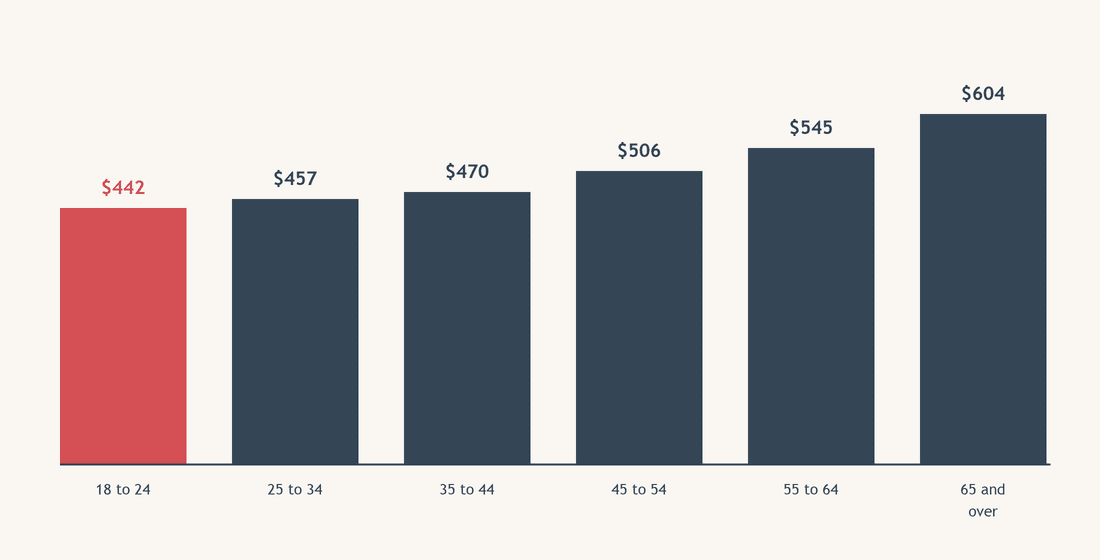
We do not record student status, so the nearest thing we can show is age. On Smarter Loans, from January 2026 to June 2026, applicants aged 18 to 24 asked for the least of any age band at the everyday scale, $442 on average, and the average rose steadily with age to $604 at 65 and over.
| Age band | Average everyday-scale request |
|---|---|
| 18 to 24 | $442 |
| 25 to 34 | $457 |
| 35 to 44 | $470 |
| 45 to 54 | $506 |
| 55 to 64 | $545 |
| 65 and over | $604 |
Source: Smarter Loans platform data, applications of $100 to $1,499, January 2026 to June 2026.
At the personal scale, applicants aged 18 to 24 asked for $5,619 on average across 1,229 applications. Education was the stated purpose on 2.9% of personal applications, averaging $6,637, and on 2.1% of everyday-scale applications, averaging $521.
The shape of that is the shape of a student's borrowing: small, specific, and often the gap before something else arrives. It is not tuition, which government aid covers, and it should not become tuition, which a personal loan at these rates is the wrong instrument for.
The term is the lever, and for a student the term has a natural end: the next disbursement, the summer job, the co-op placement.
$2,000 over eight months at 24.99% APR is about $274 a month and about $191 in interest. The same $2,000 stretched to two years costs more than twice that in interest and outlasts the need by eighteen months. A loan sized to a gap and ended when the gap closes is the cheapest borrowing on this page; the personal loan calculator runs any amount over any term, and the budget calculator checks the payment against a student month.
Two things a student should never do with a private loan: cover tuition that aid would have covered had the application been made in time, and cover a recurring shortfall. The first is a timing problem solved by applying for aid earlier; the second is a budget problem a loan makes worse. The lines of credit page covers the product that fits a recurring gap, and most students with a bank account already qualify for a small student line at their bank at a lower rate than anything here.
Yes, and the reason is the same one that lets a newcomer borrow: the lenders on this page read bank deposits, not a credit file. A student with a part-time job paying regularly into a Canadian account has the thing they assess. What most students lack, a credit history, is something these lenders work without every day.
Nineteen lenders on this page offer personal loans from $15 to $35,000 unsecured, from 0% APR up to the 35% federal cap on instalment loans. Income floors on this page run from $1,000 to $2,500 a month from any regular source, most commonly $1,500. Fourteen of the nineteen will consider a poor or empty file, and ten publish funding within 24 hours.
The catch is the income floor. A student earning below it on a part-time job does not clear the assessment alone, and that is where a co-signer comes in: a parent's income on the application meets the floor, and the guarantor loans page covers what that means for both of you. The newcomer loans page covers the empty-file case for international students specifically.
Sometimes, and the deciding factor is Canadian income rather than the passport. International students are outside the government aid system entirely, which is why they land on this page more than any other group. A lender here assesses a study permit holder the same way it assesses a newcomer on a work permit: a Social Insurance Number, a Canadian bank account with three months of deposits, and a permit whose expiry is later than the loan term. A study permit that allows on-campus or off-campus work, with that income landing in the account, meets most floors on this page; a permit that does not allow work leaves no income to assess, and no lender here lends against a tuition receipt or savings brought from home. The newcomer loans page covers the empty-file assessment in detail.
A student is the one borrower for whom a small loan repaid on time is worth more as history than as money. Twelve reported payments during a degree is a credit file at graduation; most graduates leave with none. A credit-builder product does the same for a fee without the interest, and a student card paid in full each month alongside it is the second account that turns a file into a score.
The rule: if you are going to borrow a small amount anyway, borrow it from a lender that reports, pay it on the day it is due, and let the degree finish with a file. If you do not need the money, build the file with the fee product and the card instead.
All personal loan options are on the personal loans hub. If the need is today, the same day loans page covers what that requires; if it is a single bill, the emergency loans page covers how to size it.
Source for all platform figures on this page: Smarter Loans personal loan applications, January 2026 to June 2026.
Reviewed by Vlad Sherbatov, Co-Founder and President, Smarter Loans. Last reviewed 9 September 2026. Platform figures cover applications from 1 January to 30 June 2026.

Student Loans in Canada: What You Should Know
Government student loans versus bank student lines of credit in Canada: interest during study, repayment timing, limits and how to choose.

Loans for International Students in Canada
What international students can actually borrow in Canada, why most lenders decline without a co-signer or permanent status, and the routes that work.

How To Receive Student Loan Forgiveness In Canada
Every federal and provincial student loan forgiveness program in Canada, who qualifies for each, and how to apply. Figures verified August 30, 2026.
Yes, from lenders that read bank deposits rather than a credit file, which is what the nineteen lenders on this page do. A part-time job paying regularly into a Canadian account is the file. Government student aid comes first for tuition and living costs; the loans here cover gaps and costs it does not reach.
No, where government aid would cover it. Federal student loans carry no interest while you study and repayment starts six months after you leave; a personal loan at up to 35% APR is the wrong instrument for the same money. A private loan fits a gap before a disbursement lands or a cost outside the aid assessment.
On our platform in the first half of 2026, applicants aged 18 to 24 asked for the least of any age band at the everyday scale, $442 on average, and the figure rose steadily with age. Student borrowing is small and specific: a deposit, a laptop, the weeks before a disbursement.
Yes; fourteen of the nineteen lenders on this page consider an empty or poor file, and all read deposits before the score. The obstacle is usually the income floor rather than the file, which is where a co-signer's income on the application helps.
A private loan from a lender that reports does; twelve on-time payments during a degree is a credit file at graduation. Government student loans are also reported. If you do not need the money, a credit-builder product and a student card paid in full each month build the same file for a fee rather than interest.